

In Q2 2026, one agency put Dubai Grade B rents up 31.5% on the year while another put the city average down 2% on the quarter. Dubai does not have one office market with one rent trend. It has a tight, institutionally held Grade A tier and a much larger secondary tier that is repricing at a different speed. The agency readings only look contradictory until you ask which buildings each one counts.
Why do the agencies disagree on rents?
Read the same quarter, Q2 2026, through three houses and you get three answers.
- JLL has Grade B rents up 31.5% year on year, Grade A up 26.2% and prime up 13.6%.
- Savills puts the average at AED 238 per sq ft, with no rental growth in the quarter. The report says that has not happened since H1 2021.
- Cushman & Wakefield puts the average at AED 205 per sq ft, down 2% on the quarter.
The levels cannot be compared. AED 238 and AED 205 are not two prices for the same thing. They are averages over different sets of buildings.
The direction clash is sharper. JLL reports Grade B rents up 8.7% on the quarter. Cushman & Wakefield reports the city average down 2% on the same quarter, and says the softening has been concentrated in Grade B stock. On Grade B, the two houses point in opposite directions for the same three months. The likeliest explanation is that their Grade B samples differ. We found no reconciliation by either house, so the sample difference is an inference.
A fair reader should therefore do two things. Compare each house with its own earlier readings, not with the other houses. And ask each house for its building list. Until the lists are public, a rent number is a statement about a basket, and the basket is not shown.
The agencies also measure different things. JLL reports vacancy and availability. Savills and Cushman & Wakefield report an average rent level. A rise in one can sit beside a fall in another without any error on either side.
What does "Grade B" actually contain?
Cushman & Wakefield says Grade B stock accounts for nearly 70% of Dubai's office inventory. That is the large tier. It is also the tier where agencies draw the line in different places.
In JLL's count, Grade B vacancy fell to 8.0% from 10.9%. Cushman & Wakefield, meanwhile, notes that more strata office stock has returned to the market.
JLL's vacancy ladder shows the shape of the market. Grade A vacancy is 4.2%, and JLL says it edged up marginally. Grade B is 8.0%, down from 10.9%. Grade C is 10.9%, down from 12.7%. Grades B and C improved on the year, and the lower the grade, the higher the vacancy still is.
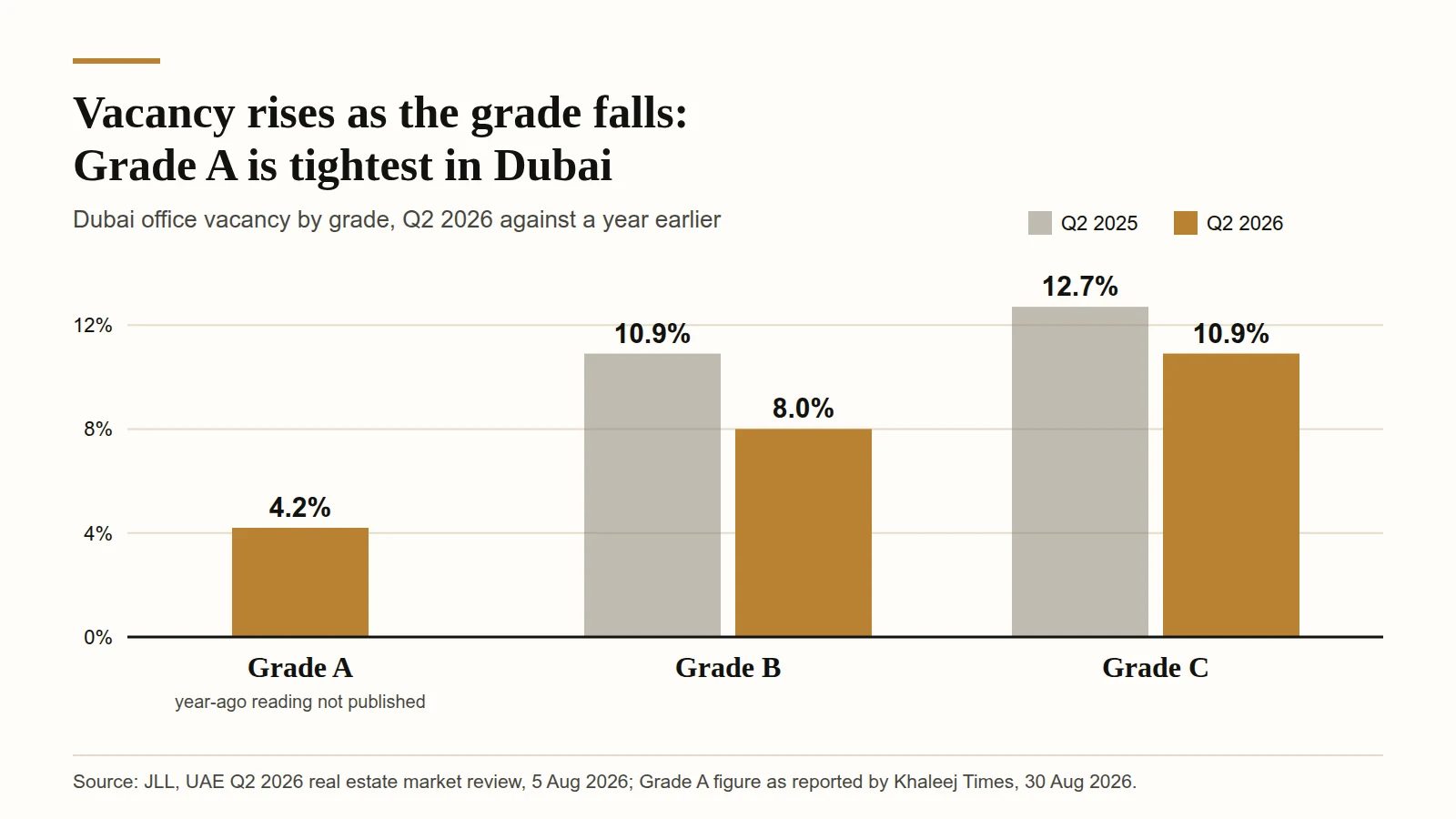
Grade B vacancy fell by 2.9 percentage points in a year, which is our arithmetic from JLL's two figures. That is a large move, and it sits beside the 31.5% rent gain in JLL's data. It does not tell us whether the tenants came from Grade A, from outside Dubai, or from newly refurbished buildings.
A refurbished tower may count as Grade A in one sample and Grade B in another. So a rent jump in Grade B can be a real catch-up, or it can be a reclassification effect. The published tables do not let an outsider tell which.
Why is Grade A still tight?
JLL puts Grade A vacancy at 4.2% and prime availability at 0.7%.
Cushman & Wakefield says Grade A, single-owned and institutional assets have remained resilient. It adds that much of the supply due this year is already pre-let.
Institutional landlords have a tool that retail owners lack. They can hold the quoted rent and give relief in the terms: rent-free months, fit-out contributions, longer breaks. That is why we expect softening to show in terms before it shows in an index. JLL says landlords held firm on pricing in Q2 and offered selective incentives. The concession data that would test this is not public, so it stays a hypothesis.
There is a tenant's side to this. Cushman & Wakefield's mid-year commentary says that buyers and tenants have more negotiating power than they did a year ago and that softening is emerging. The commentary covers the property market in general, and it does not give office figures. It is consistent with the concession story but does not prove it.
Who is exposed if the softening spreads?
The exposure sits with owners of older and multi-owner stock.
- Owners of older towers, who compete for the same tenants without an institutional balance sheet behind them.
- Owners of strata floors, who cannot fund a refurbishment as one party. Our piece on strata and single-owner towers explains why.
- Lenders who price office risk against one index, when the indices disagree.
The leasing data is not weak. JLL reports citywide vacancy of 6.1%, down from 7.7%, and rental contract registrations up 24.6% year on year. The question is price and terms, not whether space is being taken.
What should an owner of older stock decide before anything else?
The choice is between spending on the building and spending on the tenant. A refurbishment competes with a rent-free period for the same cash.
Concessions are quick and reversible. Refurbishment is slow, but it can move a building into a different sample. If agencies count repositioned stock as Grade A, the owner who refurbishes may leave the secondary tier altogether.
Neither route is free of risk. A concession lowers effective income and sets a precedent for the next renewal. A refurbishment costs cash before any tenant signs, and the tenant has to accept the new rent. An owner of a single older building, without a portfolio to spread the risk, carries both costs alone.
We do not forecast rents here. The aim is to read the split correctly. The leasing quarters after Q2 2026 will show whether Grade B owners are cutting terms or winning on quality.
What to watch
- Whether agencies publish the building lists behind their Grade B samples.
- Effective rents and rent-free periods on Grade B renewals, against quoted rents.
- Whether Cushman & Wakefield's quarterly decline repeats, and whether JLL's Grade B gain holds.
- How many refurbished towers change grade in the next agency reports.

 What Dubai tenants now ask of landlords, and which landlords say yes
 Free zone or mainland? The answer now depends on where your revenue comes from, and which authority is your landlord
 Moving to Dubai? Why new firms tend to start with a small office
 Dubai's big tenants want one landlord. What does that leave the buyer of a single floor?
 Why Dubai landlords are bringing flex operators into large floorplates
 UAE banks are healthy but choosy. So who will fund Dubai's office owners?
 Who really owns Dubai's offices? The public record is thin, so read the deals
 Has Dubai's office market peaked? The evidence points to a pause, not a top
 Millionaires are heading to the UAE, but the route to office demand is indirect
 Gulf investors know what a London office is worth. Why is a Dubai tower so hard to price?