In August 2026 a London office block changed hands inside its owner group for GBP 625m, and the price was public. The largest recent Dubai office stake sale, in 2024, came with no price. Gulf capital has a long record in European offices, but the open evidence of the last two years shows selective, yield-driven buying, not a wave. The same investors face a different office market at home, where a citywide yield does not exist and the large towers sit with long-term holders. That contrast is the real link between the two markets.
Where does Gulf money go in Europe?
It goes everywhere, and the UK is a clear target. Gulf state funds committed a record USD 53.9bn across 108 deals in H1 2026, according to Global SWF data reported by The National. The US took almost half, China was second and the UK third. Technology led the deal list, and the report gives no real estate figures.
Saudi Arabia's Public Investment Fund says it put about USD 85bn into Europe from 2017 to 2024 and aims to double its European investment by 2030. Neither figure is an office number, which is the point: the big totals do not tell us how much reaches office buildings.
The best-documented office deals we found are older. Qatar Investment Authority and Brookfield bought Canary Wharf Group for GBP 2.6bn in 2015. The Kuwait Investment Authority bought London's Willis Building from British Land in 2013. Qatar Holding took full ownership of the Porta Nuova district in Milan in 2015.
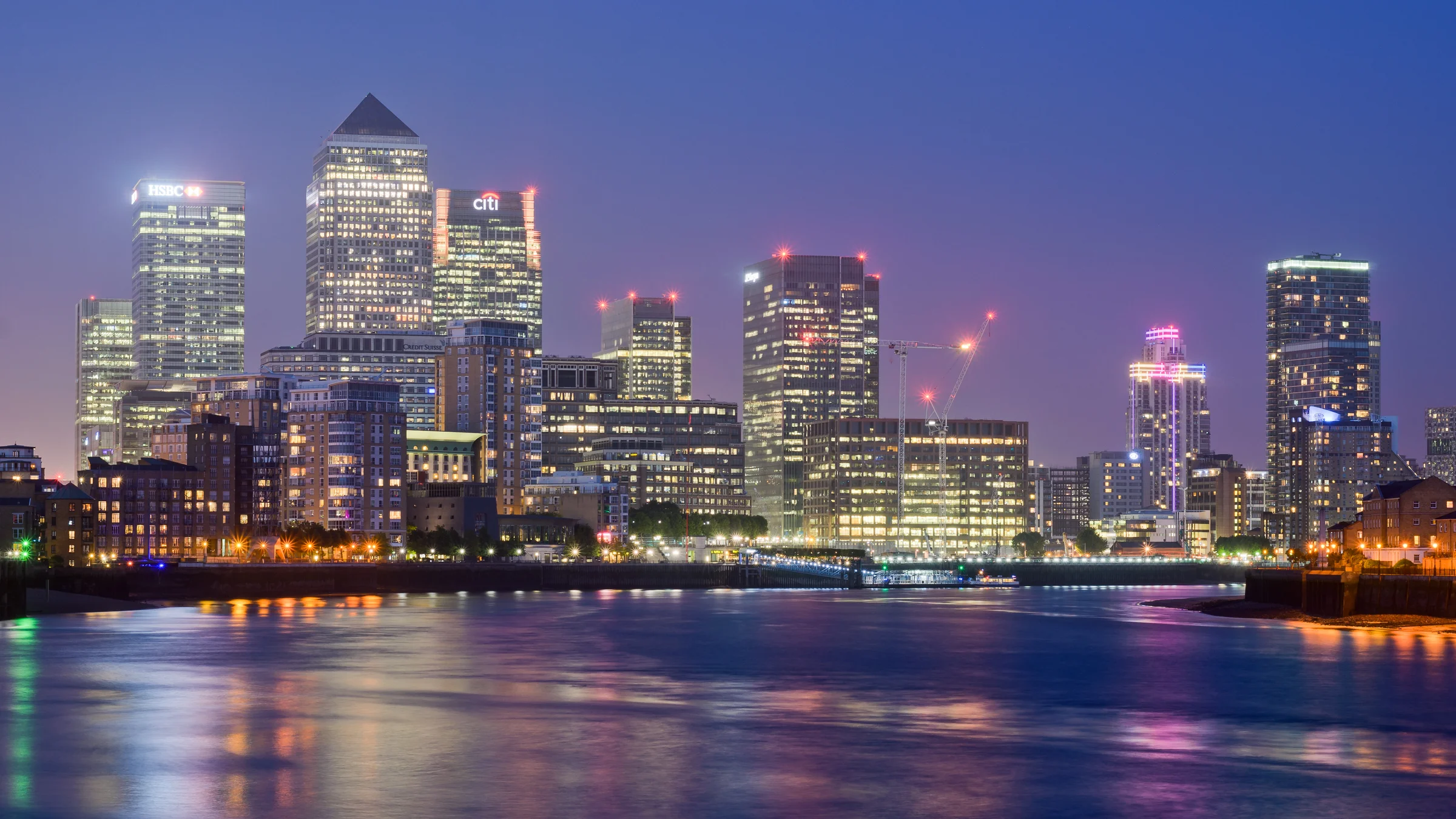
The clearest recent case comes from the same Canary Wharf partnership. In August 2026, Canary Wharf Group sold 1-5 Bank Street, a fully let office block whose main tenants are Société Générale and the European Bank for Reconstruction and Development, to its own shareholders Brookfield & QIA for GBP 625m. It was a sale inside the ownership group, not an open-market purchase, and Canary Wharf Group said it would use the proceeds to repay debt. Even so, the price was public. In the open sources we checked, we found no other Gulf office purchase of that size in Europe since 2023, which may simply mean that deals went unpublicised.
What do Gulf investors say they plan?
Surveys suggest caution about London and a wider search across the UK. AlRayan Bank's barometer of 150 Gulf investors found that one in three invested in London in the past year, but just 21% plan to in the next 12 months, down from 23% a year earlier. Liverpool, Birmingham and Manchester drew 34%, 27% and 25% of planned UK investment. The survey gives no office figures.
Private money is moving too, though the numbers do not come from the Gulf alone. In a report on Middle Eastern family offices, Knight Frank data showed about GBP 245m of family-office and ultra-wealthy money committed to UK real estate in 2025 by late August, against GBP 25m in 2024. The figure is not split by origin, and the main focus was logistics. The same report says prime offices in strong locations stay competitive.
One more line from the AlRayan survey matters for Dubai. Of the investors asked, 89% said stronger domestic opportunities are lifting their UK appetite, and 57% cited income earned at home as capital they can reinvest overseas. Home returns and overseas buying are linked.
What market are they walking into?
A thin one. MSCI data reported by IPE shows cross-border investment into Europe at its lowest level since 2013 so far in 2026. Office activity ran at about half the levels of the previous cycle, and Paris office activity fell about 20% against H1 2025. Central London office yields were back above 6%, about 100 basis points over 10-year gilts.
It was not always so. Cross-border office investment into Europe rose 46% in the first nine months of 2025, per MSCI Real Capital Analytics. That is how a European office is priced: against a quoted yield, a government bond and a trail of comparable deals.
How is a Dubai office priced at home?
Without that trail. A recent analysis of Dubai Land Department data states that no Dubai-wide office yield exists and that single-owner towers largely do not trade in the registry file, so no institutional cap rate can be derived. The sole published prime figure is a 6.11% gross yield for Dubai's financial centre from Property Monitor. The author's own estimate for strata offices in Business Bay is 7.06% in 2026, down from 8.78% in 2021.
Do not compare those numbers with London directly. One is a market yield as reported, the other a gross yield from one provider, and the strata figure is an estimate. The useful fact is that just one of the two cities has a yield series.
The largest recent Dubai office stake sale shows the same thing. In 2024 Abu Dhabi's Lunate and Saudi Arabia's Olayan Financing Company bought 24.5% each of ICD Brookfield Place. ICD & Brookfield kept 51%. The tower was over 98% occupied, and no price was disclosed. Gulf money did buy a Dubai office, and the market learned almost nothing about its price. Compare Bank Street in London, where even a sale inside the owner group came with a published price.
What does the gap tell us?
The pattern is that Gulf investors treat European offices as priced, tradable assets and Dubai offices as assets to hold. Three observations support it, and each has limits.
- European buying follows visible yields, and 2026 yields offered a margin over gilts.
- Dubai's towers sit largely with long-term owners, and the one big stake sale kept its terms private.
- Investors say home returns fund overseas buying, so Dubai income may be the source of the European cheque.
This is an inference from deals and surveys, not a measured split. No open source we opened gives the Gulf share of European office purchases, and none gives the buyer mix for Dubai towers. If a Dubai owner published a cap rate, we could test the thesis. Until then, European behaviour is the nearest public clue to how the same investors would price a Dubai tower.
Why does disclosure matter so much? A yield is the shared language of office investing. It lets a pension fund in Europe, a sovereign fund in Abu Dhabi and a family office in Riyadh compare one building with another. Where the language is missing, each buyer must build its own view, and sellers cannot point to a market price to defend theirs.
The practical meaning for a Dubai landlord is simple. A buyer who can see a 6% London yield will ask what a Dubai tower yields net of service charges and vacancy, and will want comparable deals. Disclosure helps the seller as much as the buyer.
What to watch
- A published institutional yield or cap rate for a Dubai single-owner tower.
- Any disclosed price for a stake in a Dubai Grade A building.
- Whether Gulf sovereign funds name offices, not just technology, in their European plans.
- Central London and Paris yields against government bond yields.
- Whether the share of Gulf investors planning London purchases, now 21%, keeps falling.
For the ownership side, including ICD Brookfield Place, see who buys Dubai offices. For the regional contest, see Riyadh versus Dubai.
Hear how owners and investors price Dubai offices at “Dubai Office Summit”.
Sources
- The National: Gulf state funds committed USD 53.9bn across 108 deals in H1 2026
- Gulf News: PIF about USD 85bn in Europe 2017 to 2024
- Construction Index: QIA and Brookfield bought Canary Wharf Group for GBP 2.6bn in 2015
- Infrastructure Investor
- Middle East Construction News: Qatar Holding took full ownership of Porta Nuova, Milan, in 2015
- Property Investor Today: AlRayan Bank barometer, 150 investors
- Future Family Office
- IPE Real Assets
- Knight Frank
- Fahad Al Kuwari: No Dubai-wide office yield
- Gulf News: Lunate and Olayan 24.5% each of ICD Brookfield Place in 2024
- Property Week
- Bisnow: Same sale
 What Dubai tenants now ask of landlords, and which landlords say yes
 Free zone or mainland? The answer now depends on where your revenue comes from, and which authority is your landlord
 Moving to Dubai? Why new firms tend to start with a small office
 Dubai's office supply wave is coming. The real question is who will own it
 Dubai's big tenants want one landlord. What does that leave the buyer of a single floor?
 Why Dubai landlords are bringing flex operators into large floorplates
 UAE banks are healthy but choosy. So who will fund Dubai's office owners?
 Who really owns Dubai's offices? The public record is thin, so read the deals
 Has Dubai's office market peaked? The evidence points to a pause, not a top
 Millionaires are heading to the UAE, but the route to office demand is indirect