
In 2024 the owners of ICD Brookfield Place, a 53-storey tower in Dubai's financial centre, agreed to sell 49% of it to an Abu Dhabi fund manager and a Saudi group, and kept the 51% majority. No official table splits Dubai's office buyers by nationality, so deals like this one are the best evidence of who owns what. They point to a structure that no table yet confirms. Government-related owners appear to hold the quality core. Partners from Abu Dhabi and Saudi Arabia hold a minority stake in one such tower. Private buyers of every origin appear to trade other stock around it.
Why can't we simply count foreign buyers?
We looked for a published split of office buyers by nationality and did not find one. The sources we could open report sales by value and count, not by buyer origin.
- The market report we read on Business Bay does not report buyer nationality. It gives a broker's view that demand follows the growth of Dubai's corporate base and the relocation of international companies.
- Savills notes that Dubai Land Department figures exclude leasing activity within Dubai's financial centre, where transactions are recorded under a separate regulatory framework. If sales data is split the same way, a table built on it would miss the centre's towers.
- The nationality figures we found cover residential ownership, not offices, so we do not use them here.
So nobody can show you the split. Anyone who gives you a percentage for offices is estimating.
The gap matters beyond curiosity. A lender setting terms, an owner pricing a sale and a free-zone authority planning a campus all want to know who the marginal buyer is. If that buyer is a UAE company expanding its own footprint, demand follows its business. If it is an international investor, demand follows global capital flows and can leave faster.
What did the market buy in 2026?
A lot, and mostly in plan form.
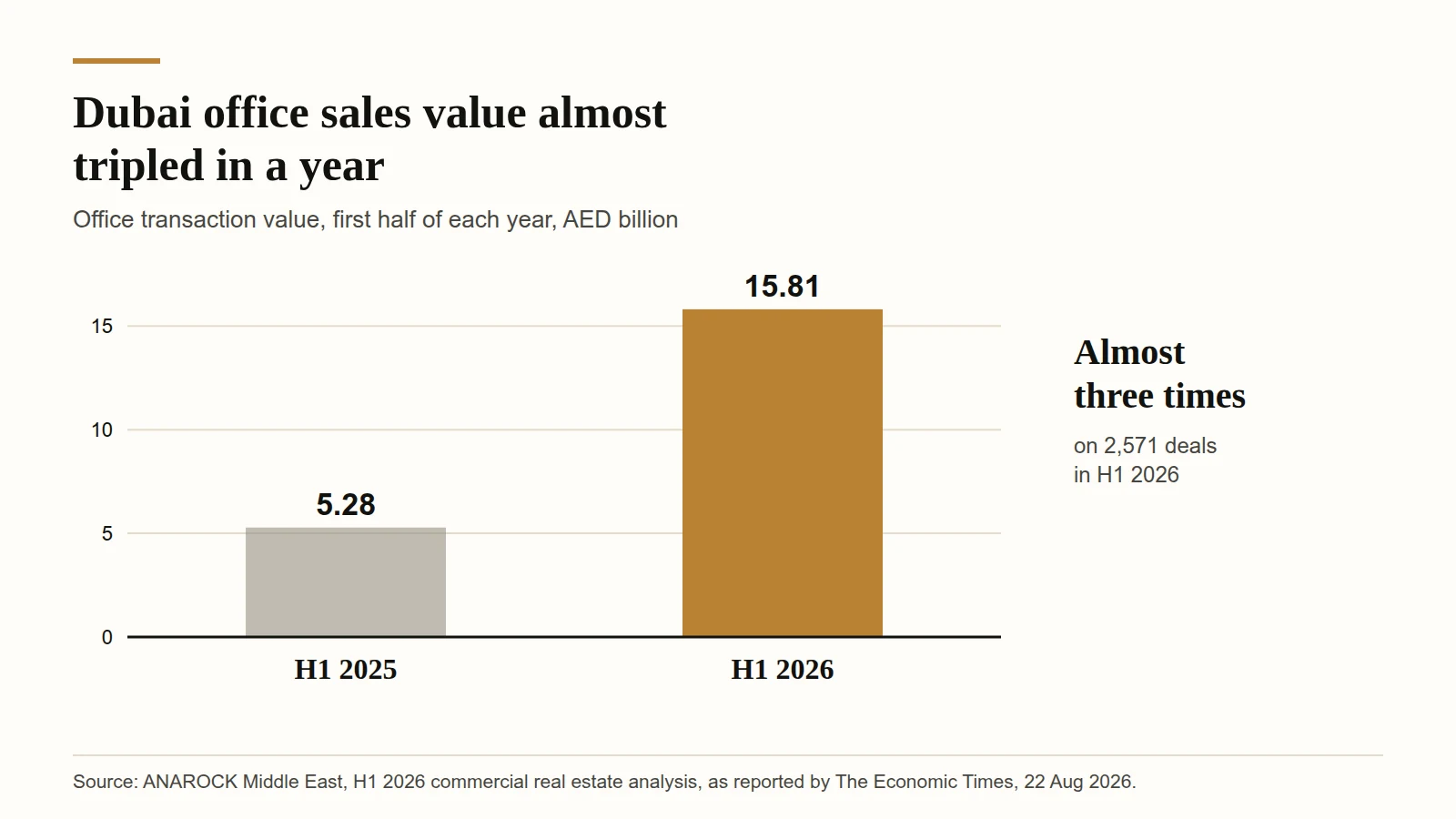
- Office transaction value rose nearly 200% to AED 15.81bn in H1 2026, from AED 5.28bn a year earlier, on 2,571 deals, according to ANAROCK.
- Cavendish Maxwell counts about 2,600 deals, with off-plan sales making up 65% of them.
- It finds more than 220 purchases above AED 20m, against 20 across both halves of 2025. Of those, 95% were off-plan.
- Business Bay took about AED 8bn of the half-year value, more than half, W Capital says.
The two houses use slightly different counts of deals. We quote each with its source and do not mix them.
Which deals show the pattern?
Three named deals show the range of buyers.
- Vision Tower, Business Bay: AED 124m for about 40,000 sq ft, bought by a UAE-based company that was not named. The report describes the buyer as a local firm expanding its own footprint.
- Emaar Square Building 3, Downtown Dubai: AED 725m, against AED 505m paid in November 2024, a 21-month hold. The sellers' announcement does not identify the buyer.
- ICD Brookfield Place: in 2024 Lunate and Olayan Financing Company agreed to take stakes in a tower in Dubai's financial centre, as set out in the case study below.
The Vision Tower price gives a rough yardstick. AED 124m for about 40,000 sq ft is about AED 3,100 per sq ft, on our arithmetic. ANAROCK reports an average office price of AED 3,202 per sq ft, up 85% year on year, for H1 2026. The named deal sits close to the average, so it is not an outlier.
The Emaar Square deal shows how fast a whole building can change hands. A seller who held for 21 months and sold for AED 220m more is, by its own account, an active investor recycling capital, not a long-term holder.
The mix of off-plan and ready stock in the data also matters. A buyer of an off-plan floor is buying a promise of delivery, often years ahead. A buyer of a ready building is buying income. They are different investors even when they sit in the same statistic.
Case study: who owns ICD Brookfield Place?
Grade A towers tend to have single owners with long horizons, and ICD Brookfield Place is a worked example. It stands in Dubai's financial centre. Cushman & Wakefield describes it as 282 m tall, with 53 storeys and LEED Platinum certification. The same page gives the office area as over 900,000 sq ft and, elsewhere, as 980,186 sq ft, so we use "about 1 million sq ft" and no more precise.
In April 2024 the tower's owners agreed to sell a minority stake. Enterprise reported the joint statement of the parties, and Gulf News gives the same split:
- A Lunate fund takes 24.5%.
- Olayan Financing Company takes 24.5%.
- The Investment Corporation of Dubai (ICD), the Dubai government's principal investment arm, and Brookfield retain the remaining 51%, split equally, so about 25.5% each.
We found no later public notice of completion, so we describe the split as agreed. Financial terms were not disclosed. Enterprise notes that Bloomberg had earlier valued the tower at USD 1.5bn, which is a press estimate and not a deal price, so we derive no price per square foot from it. The joint statement said the tower was over 98% occupied at the time of the announcement. Gulf News reports that Brookfield Properties continues to manage the tower.
The buyers describe their logic in public terms. Lunate's managing partner said the deal "further supports our Long Term Capital strategy to invest in premium assets", according to Gulf News. The same report says Lunate had USD 105bn of assets under management as of 31 March 2024, and describes Olayan Financing Company as holding a portfolio of over 32 companies, with investments from Saudi Arabia and the wider Middle East to North Africa, Turkey and India.
Three features of the deal stand out:
- The sellers kept 51% between them, and Brookfield Properties continues to manage the tower.
- The buyers are Gulf institutions, so the capital stays in the region.
- The deal covers a share of a stabilised building, over 98% let at announcement, so the buyers take little leasing risk.
For a single-owner Grade A tower, that is a template for bringing in new capital without opening the building to many owners. Free-zone authorities also build for their own accounts. DMCC's Uptown Place is targeted for Q1 2028, and Dubai's financial centre plans a new Zabeel District. We cannot publish a full ownership map. That is the test our thesis needs.
Can the ICD Brookfield Place model travel?
Each partner in this tower contributes a different thing:
- The government owner brings patience and a local standing.
- The global manager brings operating skill and a leasing platform.
- The regional institutions bring capital that wants a long hold in the Gulf.
Whether another Dubai office can copy this depends on the building. It needs a full tenant roll, a strong address and an owner willing to share. Few towers meet all three. Strata buildings, where floors have many owners, cannot do it at all without a different structure.
The counterpoint is speed. Co-ownership adds partners, and partners add decisions. A single owner can act faster on a refurbishment or a sale, and investors who want control may prefer that. We have found one such deal in public, not a list of comparables, which is why it stays a worked example rather than a pattern.
What limits more institutional money?
Three limits show in the data we have.
- Strata fragmentation, which makes a block of floors hard to assemble. See our piece on strata and single-owner towers.
- Ticket size. A whole building such as Emaar Square 3 costs hundreds of millions of dirhams.
- Thin data. Without a buyer split, a lender or fund cannot size who the next seller is.
Occupier capital is a different story. Dubai attracted 1,253 greenfield FDI projects worth USD 8.83bn in 2025. That money funds firms and jobs, not building purchases, and it should not be read as office buying.
The named deals suggest a stable core, a minority-stake route for outside partners, and a fast-trading layer beneath. A published buyer split would confirm or break that picture. Until one exists, any claim about foreign share in Dubai offices is an estimate, and we would rather say that plainly than offer a number that no source supports.
What to watch
- Whether a public office-buyer table appears from the Dubai Land Department or from a major broker.
- Resale of off-plan office units, which tests how many buyers are traders.
- More minority stakes sold in single-owner towers, and who buys them.
- Whether regional institutions buy together or alone.
- Hold periods on whole-building sales after Emaar Square 3.
- How lenders treat multi-party ownership of one asset.
Join the discussion at “Dubai Office Summit”.
Sources
- The Economic Times: H1 2026 office value nearly 200% up to AED 15.81bn from AED 5.28bn
- Zawya: About 2,600 deals
- Property Time: Business Bay about AED 8bn, 814 deals, more than half of value
- Savills: DLD figures exclude leasing in the financial centre
- Dubai Week
- Dubai Biz Guide: Emaar Square Building 3 AED 725m
- Lunate: ICD & Brookfield sell 49%
- DMCC: Uptown Place Q1 2028
- Dubai Media Office: Dubai greenfield FDI 2025, 1,253 projects, USD 8.83bn
- WAM: Zabeel District launch
 What Dubai tenants now ask of landlords, and which landlords say yes
 Free zone or mainland? The answer now depends on where your revenue comes from, and which authority is your landlord
 Moving to Dubai? Why new firms tend to start with a small office
 Dubai's office supply wave is coming. The real question is who will own it
 Dubai's big tenants want one landlord. What does that leave the buyer of a single floor?
 Why Dubai landlords are bringing flex operators into large floorplates
 Has Dubai's office market peaked? The evidence points to a pause, not a top
 Millionaires are heading to the UAE, but the route to office demand is indirect
 Gulf investors know what a London office is worth. Why is a Dubai tower so hard to price?