
TL;DR
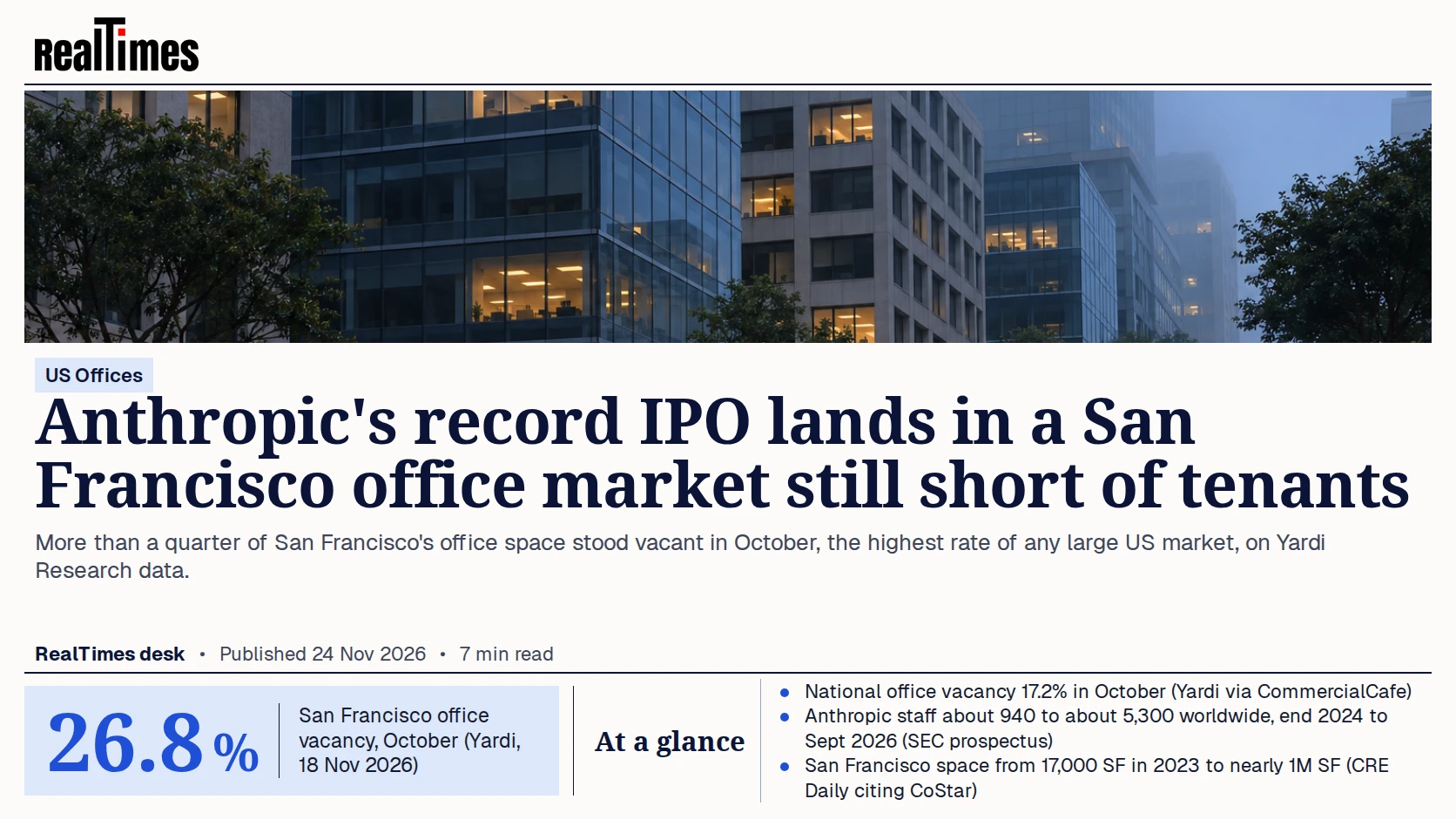
- San Francisco office vacancy averaged 26.8% in October, 60 basis points higher than a year earlier and the highest of the large US markets tracked, against 17.2% nationally (CommercialCafe, Yardi data).
- The 980 million-share Anthropic offering priced on 18 November raised about $81.3B, the largest IPO on record (Anthropic, TechCrunch).
- Anthropic's workforce grew from about 940 at the end of 2024 to about 5,300 worldwide by 30 September 2026, according to its SEC filings (SEC); its San Francisco space went from a 17,000 SF building in 2023 to nearly 1M SF, per CRE Daily citing CoStar (CRE Daily).
- Developers are lining up skyscraper sites near Anthropic's Howard Street campus, but a new tower needs an anchor tenant and few companies can fill one (SF Standard).
San Francisco has just produced the largest IPO on record, and its office towers are still looking for tenants. The Anthropic offering priced on 18 November, raising about $81.3B (TechCrunch), while more than a quarter of the city's office space stood vacant in October (CommercialCafe).
What does a record offering change for San Francisco offices?
The offering of 980 million Class A shares priced on Wednesday 18 November, and Anthropic began trading on Nasdaq under the ticker ANT the next day (Anthropic). The offering raised about $81.3B, ahead of the $75B SpaceX record, at an IPO price of $83 a share and a valuation of roughly $1.5T on a fully diluted basis (TechCrunch). AP also reported it as the largest IPO on record (AP via Boston Globe). Of the shares, 956.35 million were sold by the company and the rest by existing stockholders (Anthropic).
Our reading: for landlords the number that counts is people, not proceeds. The registration statement Anthropic first filed with the SEC on 26 October (S-1), and repeated in the final prospectus of 19 November (SEC), puts the workforce at about 940 at the end of 2024 and about 5,300 by 30 September 2026. Those are worldwide figures. The filing places the headquarters in San Francisco and says the company has "a substantial presence" in the Bay Area (SEC).
The same filings record a San Francisco office lease signed in January 2026, with a twelve-year initial term that starts in January 2027 (SEC).
How much of downtown does Anthropic already occupy?
In 2023 the company worked from a 17,000 SF building in Jackson Square. Today the company holds nearly 1M SF in the city, per CRE Daily citing CoStar (CRE Daily).
Its first big lease came that same year, when it took 230,000 SF from Slack at 500 Howard St., the SF Standard reports (SF Standard). It then added two floors at 505 Howard St. and agreed to lease the empty tower at 300 Howard St., which DivcoWest & Blackstone bought at a deep discount and are renovating (SF Standard).
The headquarters moves into 300 Howard St., a tower of more than 400,000 SF, in stages during 2027, according to CRE Daily (CRE Daily). Brokers now market the Howard Street corridor as "AI Alley" (SF Standard). CRE Daily, citing CoStar, reports that the blocks near Salesforce Tower have become known as "Anthropic Row" (CRE Daily).
How short of tenants is San Francisco's office market?
Still well short. Yardi Research data published by CommercialCafe on 18 November put San Francisco office vacancy at 26.8% in October, 60 basis points higher than a year earlier, in buildings of 25,000 SF or more (CommercialCafe; CRE Daily). That is the highest rate of the markets in the report. Nationally, vacancy fell 140 basis points over the year to 17.2%.
Average asking rent in San Francisco was about $64 per square foot in October, and office sales in the city passed $3B in the year to date (CommercialCafe).
For background, Cushman & Wakefield's latest quarterly count, for the end of September, measures a different stock. Its overall vacancy rate stood at 29.3%, after a fall of 50 basis points over the quarter, and absorption stayed positive, meaning more space was taken up than given back. AI companies leased just over 4.4M SF in the first three quarters of 2026 (Cushman & Wakefield, Q3 2026).
Our reading: AI demand is real, but it fills the city one building at a time. On both of these counts, more than a quarter of San Francisco's office space is still empty.
Why are developers looking at skyscrapers again?
Developers, and Wall Street, are racing to build skyscrapers in San Francisco again despite high office vacancy, the SF Standard reports, with Anthropic expected to need more space as a public company (SF Standard). The catch is finance. Lenders and investors want an anchor tenant committed to a tower before they fund it, and few companies can grow into that much space. The closest sites to AI Alley include the former Oceanwide site at First and Mission and the former PG&E building at 77 Beale Street (SF Standard).
The tenant at the centre of that bet sounds less pressed. Anthropic's prospectus says the company believes its current office facilities are adequate for its current needs, and that suitable additional or alternative space will be available should it be needed (SEC). With city vacancy at 26.8% on Yardi's measure, against 17.2% nationally, the market gives it reason to think so. Our reading: that leaves large tenants with the stronger hand in any lease talks, and speculative towers waiting for a signature.
Why it matters
Our view: San Francisco's office recovery now rests on a few very large AI tenants. Anthropic grew from about 940 to about 5,300 staff worldwide in under two years (SEC), yet city vacancy on Yardi's measure was 26.8% in October, higher than a year earlier.
If Anthropic and its peers keep hiring at that pace and commit to new towers, then the sites near AI Alley could move from plans to financing, because an anchor tenant is what lenders ask for (SF Standard). If hiring slows, then the city loses its strongest source of office demand while vacancy sits far above the 17.2% national rate, and the new towers stay on paper.