
TL;DR
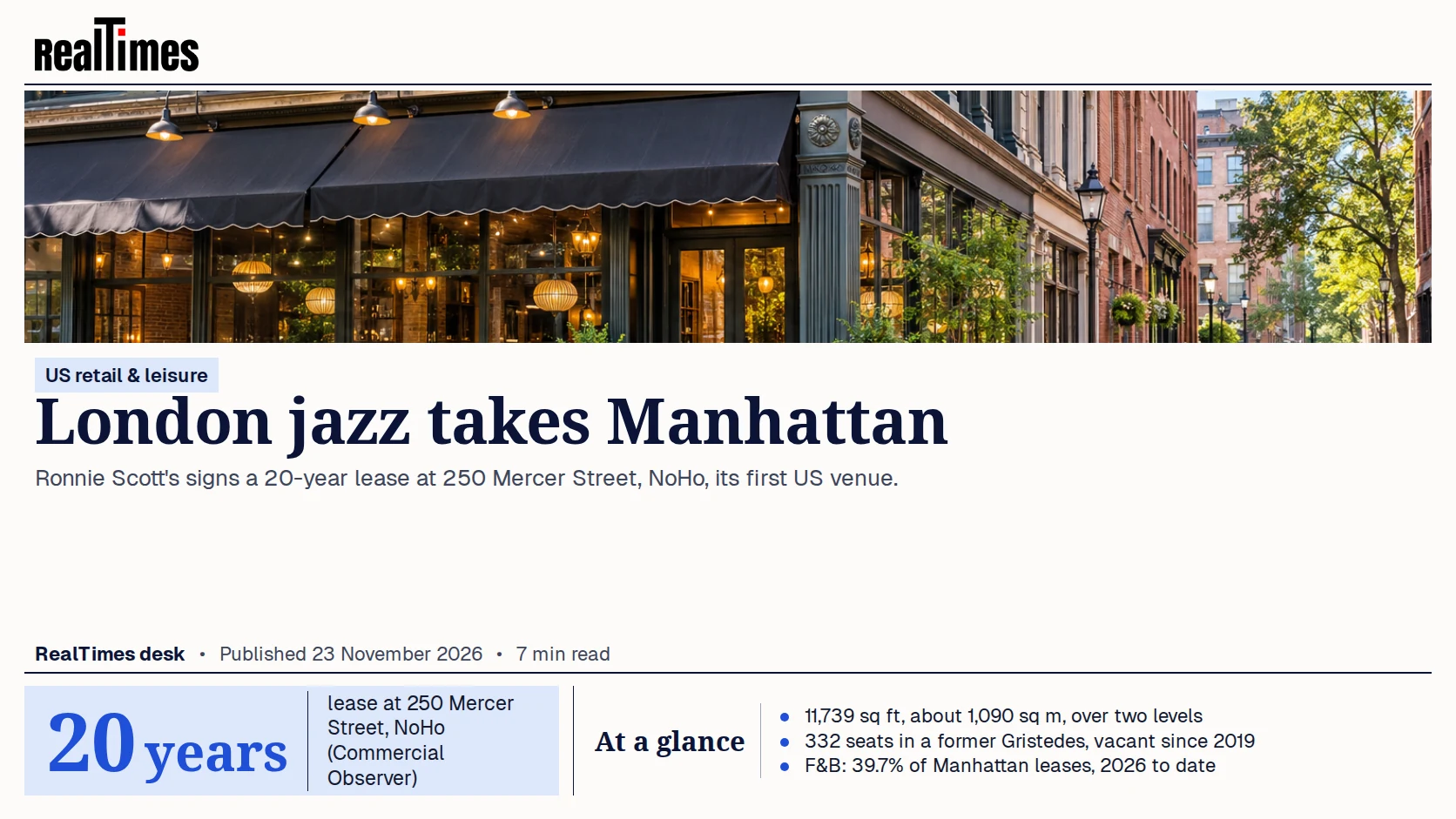
- Ronnie Scott's, the jazz club that opened in London's Soho in 1959, has signed a 20-year lease for 11,739 sq ft, about 1,090 sq m, at 250 Mercer Street in Manhattan's NoHo, Commercial Observer reported on 19 November. It will be the club's first US venue.
- The plan itself was public in January 2026, when Manhattan's Community Board 2 reviewed the club's liquor licence application for the address. What is new is the signed term: 20 years, agreed at the end of September.
- The desk reads the deal as a marker of who is now leasing Manhattan ground floors: food & beverage took 39.7% of leases signed this year, per Cushman & Wakefield.
A corner unit that sold groceries for a decade and then sat empty for seven years is set to sell ticketed jazz sets and dinner. The tenant is a London jazz institution, and it has committed to the space for two decades.
What did Ronnie Scott's sign?
The club has taken 11,739 sq ft at 250 Mercer Street on a 20-year lease, according to Commercial Observer. The landlord is Mercer Square Owners Corporation, and Cory Zelnik & Jeremy Banilevi of Zelnik & Company represented both the tenant and the landlord, the paper reports. The asking rent was $1.1m a year. The deal was signed at the end of September.
"This was a yearlong negotiation which is not atypical for a deal like this," Zelnik told Commercial Observer. The club plans 332 seats for ticketed shows and dinners. The report gives no opening date.
The brand is growing at home too. Ronnie Scott's was due to open Upstairs At Ronnie's on 6 February, a 140-capacity room above the Soho club that had stood unused since the venue closed for a revamp in 2024, Time Out reported on 19 January.
What was already public before the lease report?
Most of the physical plan. On 22 January 2026 the full board of Manhattan's Community Board 2 adopted a resolution on an application by Ronnie Scott's Jazz Club LLC for an on-premises restaurant liquor licence at 250 Mercer Street, described as "the NYC outpost of the UK-based Ronnie Scott's London". The board's letter to the New York State Liquor Authority is dated 26 January, per the CB2 resolution.
The resolution already gave the size: 7,406 sq ft on the ground floor and 4,333 sq ft in the basement, used by patrons for bathrooms only. It set out 97 tables, 332 seats and a proposed legal occupancy of 400. The space, inside the NoHo Historic District, was a Gristedes supermarket from about 2009 to 2019 and has been vacant since 2019.
The applicant signed 21 stipulations. Entry will be for ticketed events only, outside a cap of 12 private parties a year. Sound must be fully contained by a qualified engineer, and there will be no sidewalk seating and no televisions. The board's main concern was traffic from crowds arriving and leaving at show times on a single-lane street. By a unanimous vote, with 36 board members in favour, it recommended denial unless those stipulations are written into the licence, which makes the board's support conditional on them.
So the new facts in the 19 November report are commercial, not physical: the 20-year term, the September signing, the landlord, the brokers and the asking rent.
Why are music and dining operators taking Manhattan ground floors?
Food & beverage leads Manhattan leasing. It took the largest share of deals so far this year, 39.7% of leases signed year to date, according to the third-quarter report by Cushman & Wakefield. The same report puts retail availability at a historic low of 9.8% and the average ground-floor asking rent at $730 per sq ft, up 5.2% year on year. In SoHo, NoHo's neighbour, availability stands at 7.7%.
CBRE counts the same squeeze. Direct ground-floor availabilities across Manhattan's 16 prime corridors fell to 151 from 170 in the third quarter, it reported on 7 October. The average asking rent rose 5% year on year to $707 per sq ft.
The desk sees a pattern in that data. Apparel took 21.2% of deals, concentrated in SoHo and on Madison Avenue, per Cushman & Wakefield, and food brands compete for the same prime frontage. A large box with a basement, off the main shopping streets and empty since a supermarket left, suits a destination operator instead: guests buy a ticket and come for the show, not for passing trade.
250 Mercer Street at a glance
| Item | Figure | Source |
|---|---|---|
| Lease term | 20 years, signed end of September 2026 | Commercial Observer |
| Size | 11,739 sq ft (7,406 ground, 4,333 basement) | CB2, Commercial Observer |
| Seats | 332, legal occupancy 400 proposed | CB2 |
| Asking rent | $1.1m a year | Commercial Observer |
| Previous use | Gristedes, about 2009 to 2019, vacant since | CB2 |
| Manhattan F&B share of leases | 39.7%, 2026 year to date | Cushman & Wakefield |
Why it matters
Our view: a 20-year commitment from a ticketed music venue turns a unit that sat empty since 2019, per CB2, into long income, at a time when food & beverage already takes 39.7% of Manhattan leases. For landlords of large, awkward ground floors, culture and dining are now the credible bidders.
If the club opens on the terms agreed with the board and fills its 332 seats, then more European music and hospitality brands are likely to treat long Manhattan leases as a way into the US, and landlords to price such boxes off a show, not a shop window. If licensing, fit-out or traffic conditions slow the opening, then the 20-year term stays a headline until the doors open, and the space keeps its long vacancy record a while longer.