

TL;DR
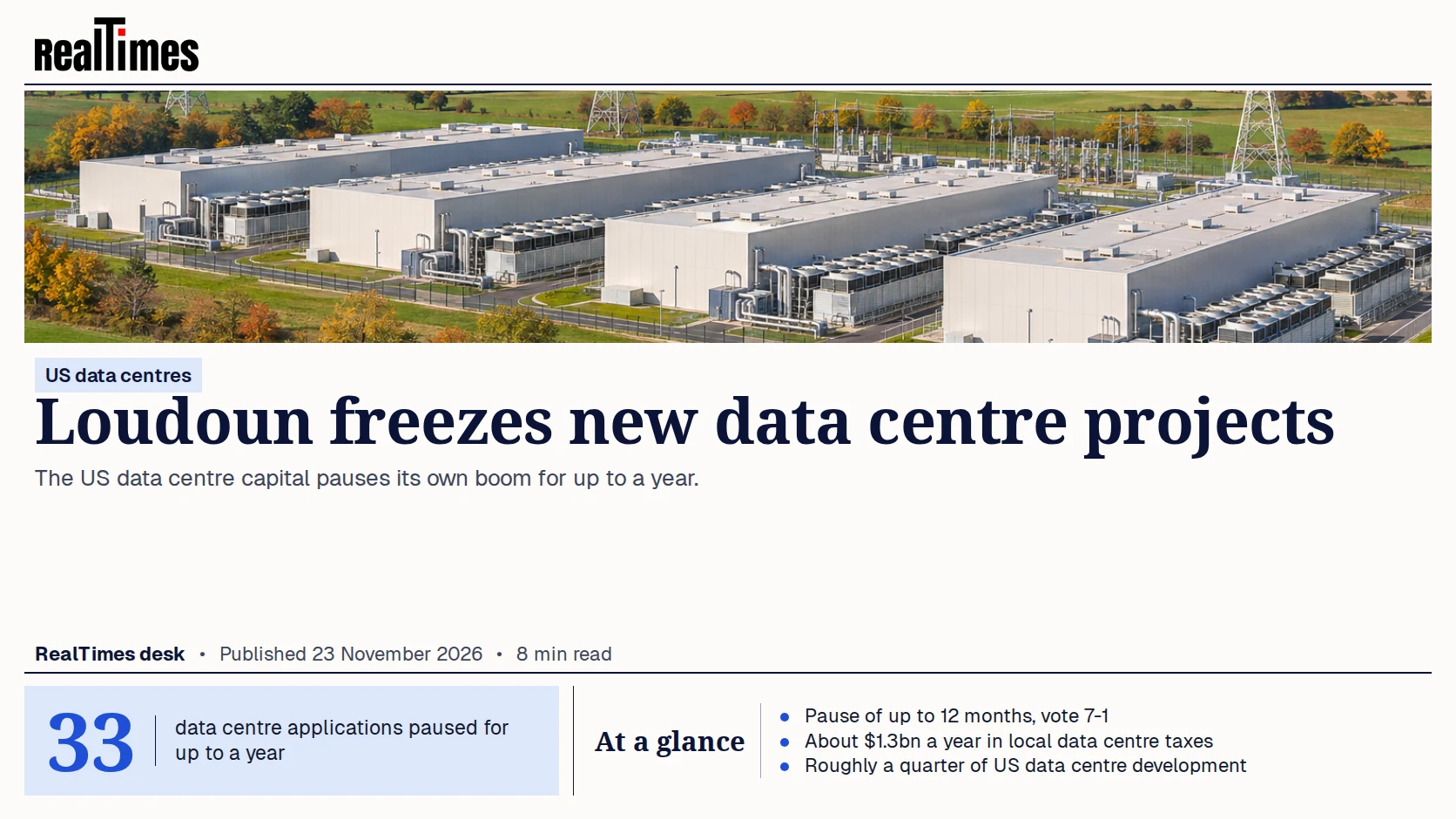
- Loudoun County's Board of Supervisors voted 7-1, with one abstention, on 17 November to pause action on legislative data centre and substation applications for up to 12 months, Bisnow reported, with 33 active applications in the queue.
- Loudoun accounts for roughly a quarter of US data centre development and its facilities generate about $1.3bn a year in local tax revenue, according to Commercial Observer.
- The desk reads the vote as proof that data centre growth now rests on power and local permission as much as on capital. Dublin, Amsterdam, Frankfurt and Norway have each put their own brake on the sector.
The county that built the world's best known data centre cluster has decided it needs time to think. Loudoun, west of Washington, D.C., has spent two decades saying yes to server halls. This month its supervisors said: not for now.
What did Loudoun decide?
The Board of Supervisors voted on the evening of Tuesday 17 November, with Supervisor Kristen Umstattd voting no and Supervisor Caleb Kershner abstaining, per Bisnow. The pause covers legislative applications, meaning rezonings and special exceptions, for data centres and substations. It is retroactive to 15 September and runs as late as September 2027.
Virginia does not allow an outright moratorium on data centres. The county instead uses the one-year window it has to act on a legislative application, Bisnow explains. County Attorney Leo Rogers confirmed the pause is legal but warned of a "real threat of litigation" from applicants.
The county announced the formal adoption in a release after the vote. Developers can still submit applications, Commercial Observer reports, and administrative applications such as site plans and subdivision plans can proceed, per Bisnow. New substations needed for grid reliability are exempt, as are certain zoning conversions in the Route 28 corridor, according to Commercial Observer. CRE Daily also put the count of active data centre and substation applications at 33.
Why would a county brake its own tax base?
The money is large. Loudoun's data centres generate about $1.3bn a year in local tax revenue, Commercial Observer reports, and the county holds roughly a quarter of US data centre development.
Growth has outrun planning. Loudoun had about 53m sq ft of data centres in 2025, double the figure of five years earlier, according to county officials quoted by Bisnow. Supervisor Juli Briskman told the meeting that "this development of data centers has moved a lot faster than the board has been able to respond".
Power is the other pressure. Residents are pushing back against a ruling that would let Dominion Energy build high voltage lines through their properties for the Golden to Mars transmission project in eastern Loudoun, WJLA reported when the board first advanced the pause in September.
Who can still build?
Not everyone stops. About 15 projects totalling 10.5m sq ft that were already approved can proceed without the special exception process, Bisnow reports. Commercial Observer puts the number of grandfathered or administrative projects at 15 to 17.
The queue will take time to clear once the pause ends. County staff estimate four to six months of extra meetings starting in autumn 2027, Commercial Observer reports, and developers argue the delay undermines investor confidence.
Loudoun is not alone in Virginia or beyond. Prince William County tightened its data centre zoning in September and Montgomery County, Maryland, adopted an 18 month freeze in July, per Commercial Observer. Bisnow adds a yearlong New York moratorium on large-scale data centres. Loudoun itself ended by-right data centre development countywide in March 2025.
Has Europe already seen this?
Yes, and for longer. Europe's main hubs hit grid and permit limits years before Loudoun voted.
In Ireland an effective moratorium on new data centre grid connections was in place from 2021. In December 2025 the Commission for Regulation of Utilities ruled that new data centres can connect if they also generate and supply power to the grid, The Irish Times reported on 28 July. The same report cites DC Byte saying Microsoft, Amazon & Meta are "pivoting away" from Dublin, which remains constrained by grid capacity.
In Amsterdam a moratorium applies to new data centre projects larger than 70 MW, alongside power shortages across much of the city centre, W.Media reported on 17 July. In Frankfurt, CBRE's Global Data Center Trends 2026 finds grid capacity in the central area constrained, with "upgrades unlikely until the 2030s", per the same report. Developers are moving some projects about 40 km out of the city.
Norway took a different route. By March 2026 its parliament had directed the government to propose a ban on data centres used for crypto mining, while a licensing system lacked a majority, law firm BAHR wrote on 12 March. The minister of digitalisation argued that the main constraints are power capacity and the grid.
Where data centre growth meets a brake
| Market | Main constraint | Instrument | Since |
|---|---|---|---|
| Loudoun, Virginia | Local land use, grid lines | Pause on legislative applications, up to 12 months | 15 Sep 2026 (retroactive) |
| Dublin | Grid connections | Connection only if the site also generates power for the grid | Moratorium from 2021, new rule Dec 2025 |
| Amsterdam | Grid congestion | Moratorium on new projects over 70 MW | In force, 2026 report |
| Frankfurt | Central grid capacity | Rezoning limits in some municipalities | Upgrades "unlikely until the 2030s" |
| Norway | Power capacity, grid | Proposed ban on crypto mining data centres | Parliament, by Mar 2026 |
Sources: Bisnow, The Irish Times, W.Media, BAHR.
Why it matters
Our view: Loudoun shows that capital is no longer the scarce input for data centres. A county earning about $1.3bn a year from the sector chose to stop the queue, and 33 active applications in the queue now wait on rules, not on money.
If Loudoun's new standards arrive with clear locations and power terms, then approved and grandfathered sites gain value and the queue restarts in late 2027 on firmer ground. If the pause ends in litigation or a tighter map, then demand moves further out, as it has from central Frankfurt and Dublin, and land with a grid connection becomes the asset investors pay for.