
TL;DR
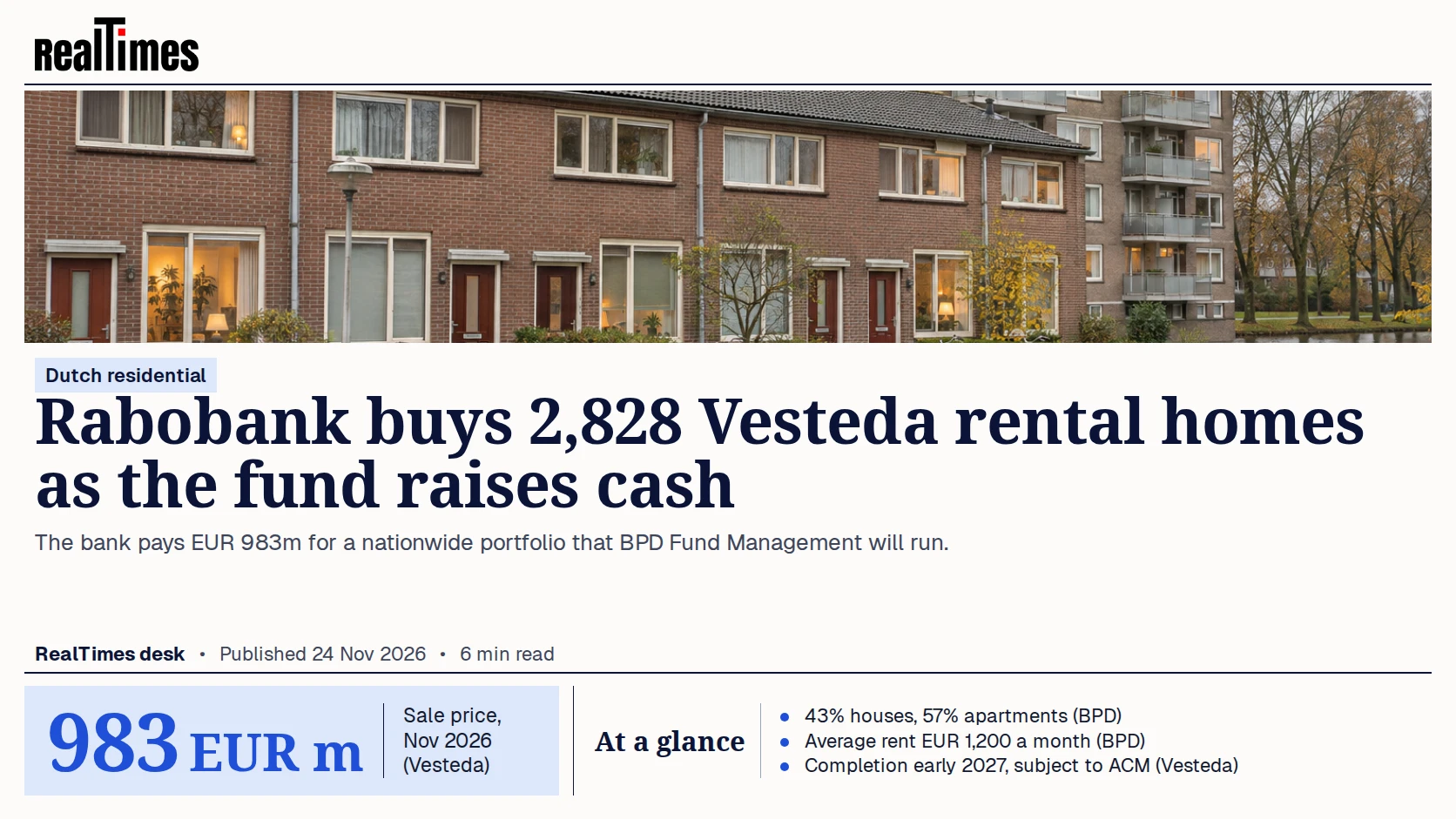
- Rabobank has agreed to buy 2,828 rental homes from Vesteda for EUR 983m. The homes go into a new portfolio managed by BPD Fund Management, part of the Rabobank group (Vesteda, 23 November; BPD).
- Vesteda says the sale helps it meet investors' liquidity needs. PropertyNL ties the proceeds to outstanding redemption requests, which reached EUR 4.1bn in March (Vesteda, 2 March) and were set at a redemption volume of EUR 765m in June (Vesteda, 26 June).
- Completion is expected in early 2027, subject to approval by the ACM, the Dutch competition authority. Rents and tenancy terms stay in force (Vesteda).
Vesteda has found a buyer for a slice of its portfolio, and the buyer is one of its own banks. Rabobank has signed to take 2,828 rental homes from the Dutch residential fund for EUR 983m (Vesteda), or about EUR 348,000 per home on the headline price, by our calculation. In March, Clifford Chance advised Rabobank and ING on a EUR 600m bridge facility provided to the same fund.
The deal was announced on the evening of 23 November as inside information under EU market abuse rules (Vesteda). ANP describes Vesteda as the largest commercial residential investor in the Netherlands, with about 28,000 rental homes, investing for pension funds and insurers among others.
What exactly is Rabobank buying?
The homes are spread across the Netherlands: 43% single-family houses and 57% apartments, mostly with energy label A or B, at an average rent of EUR 1,200 a month (BPD). Rabobank makes the investment itself. BPD Fund Management will manage the new portfolio next to BPD Woningfonds, which takes the homes it runs to just over 11,000. It expects that number to grow by about 2,000 homes a year (BPD; PropertyNL).
Both sides commissioned independent valuations before agreeing the price. The purchase agreement is signed, with completion expected in early 2027, subject to the ACM and other customary conditions (Vesteda).
The size stands out. Van Lanschot Kempen, the seller's financial adviser, calls it the largest Dutch residential transaction in recent years (Van Lanschot Kempen).
Rabobank & Vesteda: the deal at a glance
| Item | Detail |
|---|---|
| Homes | 2,828, spread across the Netherlands |
| Price | EUR 983m |
| Mix | 43% single-family houses, 57% apartments |
| Average rent | EUR 1,200 a month |
| Manager | BPD Fund Management, part of the Rabobank group |
| Completion | Expected early 2027, subject to ACM approval |
Sources: Vesteda, 23 November 2026; BPD, 23 November 2026.
Why is Vesteda selling now?
The sale closes a chapter that opened in March. Investors in the Vesteda Residential Fund filed indicative redemption requests of EUR 4.1bn, 52% of equity, in a window the fund terms open only once every seven years (Vesteda, 2 March). Vesteda pointed to strong value growth and to investors' own allocation choices. Tax changes played a part too, from transfer tax to the regime for foreign pension funds. Fund performance was not cited as a reason. ABP, which holds 33% of the fund, alone sought EUR 1.4bn, according to NOS on 3 April.
In April investors gave the fund more room: the full settlement period went from 36 to 60 months (NL Times). On 26 June they set the redemption volume at EUR 765m. Investors may now ask for redemptions every year, and Vesteda aims to provide liquidity of 7.5% of equity a year on a best-effort basis, from property sales, new debt, refinancing, the dividend and new investors (Vesteda, 26 June).
The 23 November release speaks only of investors' liquidity needs, portfolio optimisation and fund stability. Kempen is more direct: the sale enables Vesteda "to service the redemption volume as agreed on 26 June 2026" (Van Lanschot Kempen). After completion, the fund will hold about 25,000 homes worth around EUR 9.5bn, against about 28,000 homes valued at roughly EUR 10.8bn in the first quarter (Van Lanschot Kempen; Vesteda, 26 June).
From redemption requests to a portfolio sale
- 2 Mar 2026EUR 4.1bn of requests
Investors file indicative redemption requests equal to 52% of equity.
- 6 Mar 2026EUR 600m bridge
Clifford Chance announces it advised ING & Rabobank on a EUR 600m bridge facility for the fund.
- 3 Apr 2026More time
Investors extend the full settlement period from 36 to 60 months.
- 26 Jun 2026EUR 765m set
Redemption volume fixed; redemptions become possible every year.
- 23 Nov 2026Sale signed
Rabobank agrees to buy 2,828 homes for EUR 983m through BPD.
- Early 2027Completion
Expected, subject to ACM approval.
Why is a bank the buyer?
Rabobank comes to the deal in several roles. In the BPD release, Rabobank names itself as financier, as owner of BPD and as investor in BPD Woningfonds (BPD). BPD itself adds about 6,000 new homes a year (Vesteda). The bank was also one of the two banks behind Vesteda's bridge facility in March (Clifford Chance).
Our reading: the homes move from a fund backed by pension funds and insurers to a bank's own investment, while the homes keep their tenants. Both sides say the homes stay on the rental market for middle-income households (Vesteda).
What does rent regulation have to do with it?
The Affordable Rent Act has been in force since 1 July 2024. It covers a large share of Vesteda's homes. Some of them now sit in the regulated mid-rent tier, where rent rises are capped (NL Times). Chief executive Astrid Schlüter told NOS in April that the pile-up of rules had certainly not helped.
The government expected the redemptions to lead to sales of rental homes. In answers to parliament, housing minister Elanor Boekholt-O'Sullivan cited Kadaster data: about 114,000 rental homes were sold to owner-occupiers in five years, about 62,000 of them by institutional or corporate investors. The rental stock of private investors still grew from about 679,000 to 752,000 homes in 2021 to 2025, through new building (Tweede Kamer, answers of 24 April).
The same answers explain why buyer type matters. A lease survives a sale to another investor, while a sale to an owner-occupier can only follow when the tenant leaves. In this deal rents, terms and existing agreements stay in force (Vesteda). On 20 April the government also announced plans to extend the new-build rent surcharge from 2028 to 2032 and restated the coalition plan to cut transfer tax for landlords to 7% (Volkshuisvesting Nederland).
Why it matters
Our view: if the ACM clears the deal on time, Vesteda turns 2,828 homes into EUR 983m. That is more than the EUR 765m redemption volume, and the homes stay rented instead of being sold one by one as tenants leave. Then other Dutch residential funds facing exits have a template: a block sale to a long-term domestic owner, priced on independent valuations.
If investors use the new annual window to ask for more, then a fund pledged to 7.5% of equity a year on a best-effort basis will need more sales or more debt. For the mid-rent market, the test is whether such sales go to investors who keep renting, or add to the 62,000 institutional homes sold to owner-occupiers in five years.