
TL;DR
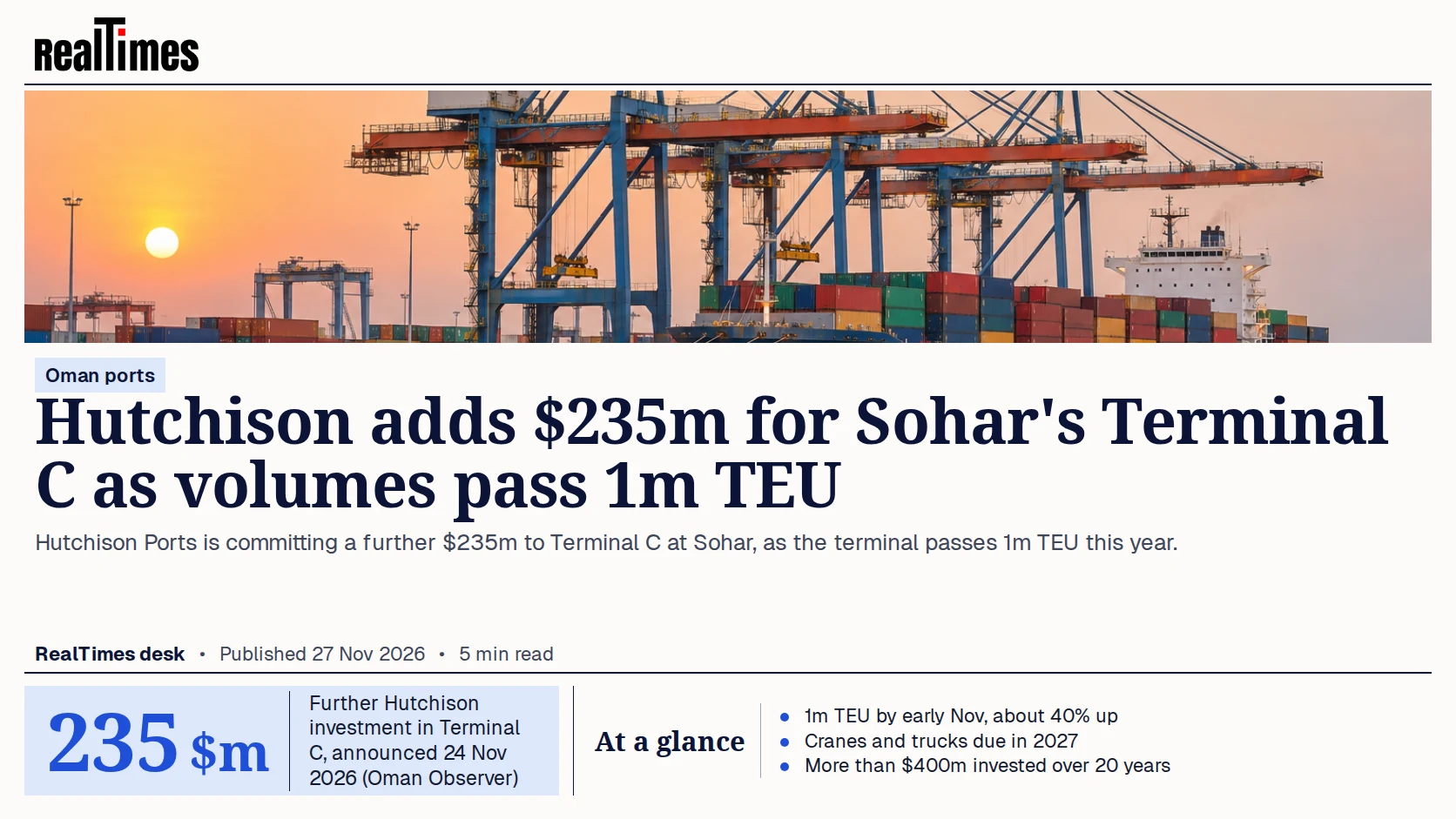
- Hutchison Ports is investing a further $235m in Terminal C at Sohar, Oman, announced on 24 November at an event marking 20 years of its operations in the country (Oman Observer).
- The terminal handled 1m TEU by early November 2026, about 40% more than in the same period of 2025 (Oman Observer).
- The money covers automated electric rubber-tyred gantry cranes and autonomous trucks due in 2027, on top of more than $400m spent in Sohar over 20 years (Oman Observer).
Hutchison Ports is paying for more capacity at Sohar on Oman's Sea of Oman coast, as volumes rise. Hutchison Ports Sohar says rising cargo volumes drove the decision (Vessels).
What exactly is Hutchison paying for?
Eric Ip, Group Managing Director of Hutchison Ports, said the $235m covers automated electric rubber-tyred gantry cranes and autonomous trucks expected to arrive in Sohar in 2027 (Oman Observer). He also named smarter digital systems and stronger sea, road and future rail connections as part of the plan (Oman Observer).
The terminal is run through Oman International Container Terminal (OICT), the operating entity of Hutchison Ports Sohar (Oman Observer). Alroya, in its own Arabic report, describes the programme as aimed at capacity, handling efficiency and lower emissions (Alroya).
The announcement gives no crane or truck count, no berth change and no capacity uplift in TEU, according to Vessels. The figures come from remarks at the event, as reported by the outlets listed below.
How fast is Sohar growing?
By early November the terminal had handled 1m TEU this year, about 40% more than in the same period of 2025, according to Anacin Kum, CEO of Hutchison Ports Sohar (Oman Observer). More than 300,000 TEU of regional imports and exports moved through it in the first ten months of 2026 (Oman Observer).
Sohar container terminal, 2026 figures
The two figures measure different things and should not be added together, as Vessels points out. Kum also expects cumulative throughput since 2006 to exceed 10m TEU this year (Oman Observer).
What does 20 years of investment show?
Hutchison signed its concession in 2005 and began operating Terminal B in 2006 (Oman Observer). It moved to the much larger Terminal C in 2014, although Terminal B was still less than half full, investing ahead of anticipated demand (Oman Observer). Ip put the total at more than $400m over the 20 years (Oman Observer).
That earlier move let the terminal take larger vessels. It now serves ships from regional feeders to some of the world's largest container carriers, Ip said (Oman Observer).
Hutchison Ports in Sohar: from concession to Terminal C
- 2005Concession signed
Hutchison Ports signs its Sohar concession.
- 2006Terminal B opens
Operations begin; cumulative throughput is expected to pass 10m TEU in 2026.
- 2014Move to Terminal C
A substantially larger terminal, while Terminal B was less than half full.
- 2027New equipment due
Automated electric cranes and autonomous trucks arrive.
Does the Sohar location matter for shipping routes?
Oman Observer notes that Sohar's position on the Sea of Oman, outside the Strait of Hormuz, has proved valuable amid changes to regional shipping routes (Oman Observer). In 2026 the terminal worked with carriers and cargo owners on overland connections to other GCC markets, giving goods another route during regional disruption (Oman Observer).
No source gives transit volumes, journey times or freight rates for those routes (Vessels). Any link between the 40% growth and rerouting of Gulf cargo is therefore our reading, not a reported fact.
What is still open?
Hutchison has given no full-year throughput forecast and no return estimate for the $235m (Vessels). Future rail is named as an opportunity, but no operator, route or timetable is published (Vessels). The company aims for net-zero emissions from its own operations by 2030, and Omanisation at the terminal is about 90% (Oman Observer).
Why it matters
Our view: a port that spends $235m after moving to Terminal C in 2014 while Terminal B was less than half full is making a long bet on Oman's role as a Gulf gateway. If the 40% growth to 1m TEU holds into 2027 when the new equipment arrives, then the case for warehouses and logistics land near Sohar strengthens, as cargo waiting for inland trucks or rail needs space close to the quay. If the 300,000 TEU of regional trade stays a small share of the total, then the terminal depends on transhipment and Omani volumes, and occupiers should ask for volume data before committing to space.