
TL;DR
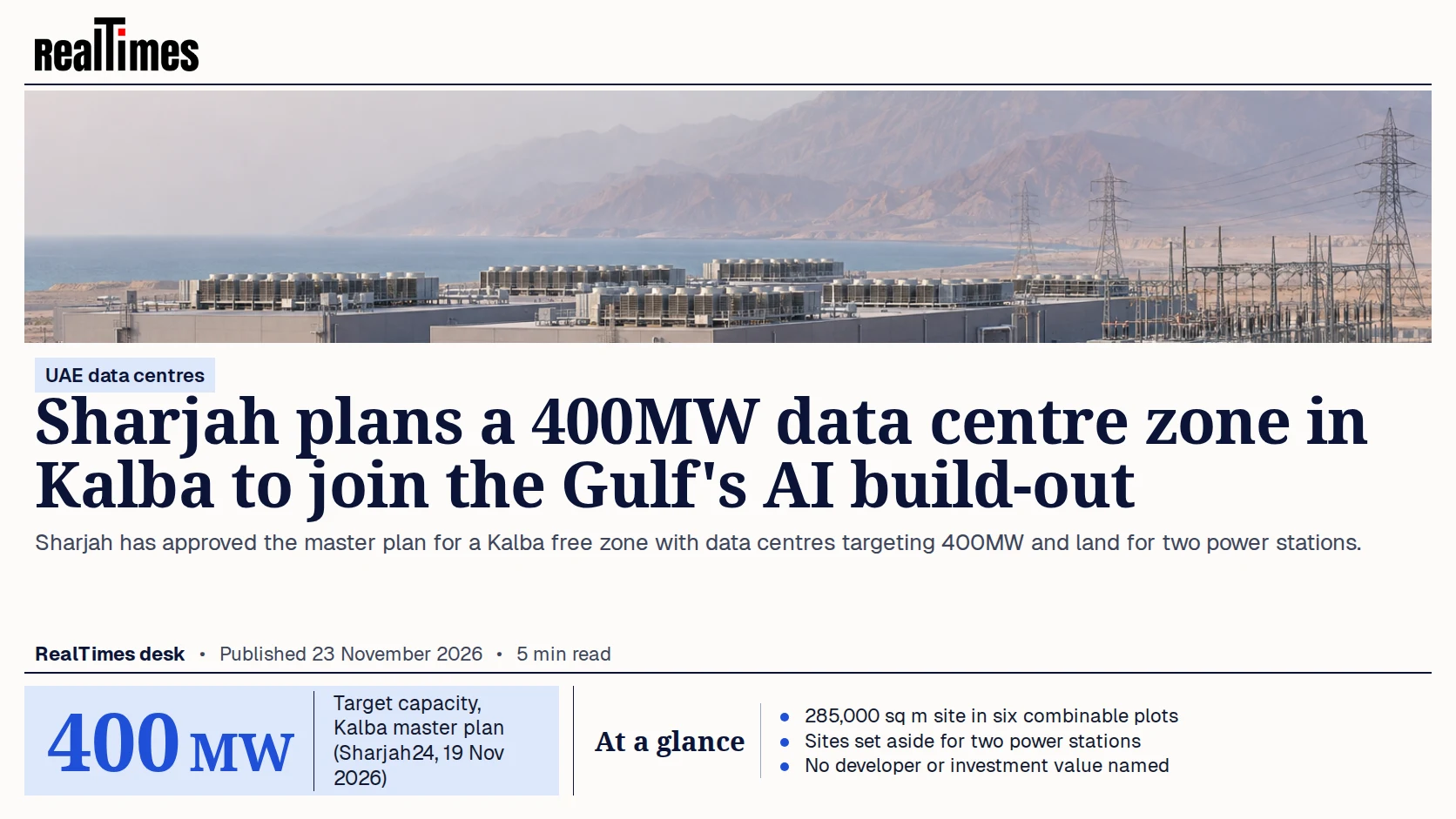
- Sheikh Dr Sultan bin Ahmed Al Qasimi, Deputy Ruler of Sharjah, has approved the master plan for the Sharjah Communications Technology Free Zone in Kalba, with a data centre complex targeting 400MW in total (Sharjah24).
- The 285,000 sq m site is split into six plots that can be combined, and the plan sets aside sites for two power stations to serve the data centres (Sharjah24).
- The announcement names no developer, operator or investment value, and gives no construction timeline (CBNME).
Sharjah has drawn its place on the Gulf's data centre map, and it has drawn it around power. The master plan announced on 19 November for a free zone in Kalba, on the emirate's east coast, reserves land for two power stations next to a data centre complex with a target total capacity of 400MW (Sharjah24). What it does not yet have is a developer, an operator or a price tag (CBNME).
What has Sharjah approved?
The approval came from Sheikh Dr Sultan bin Ahmed Al Qasimi, Deputy Ruler of Sharjah and Chairman of the Sharjah Communications Technology Authority (SCTA), according to the government news portal Sharjah24. It covers the master plan of the Sharjah Communications Technology Free Zone in Kalba, which he described as the bedrock of the authority's activities (Sharjah24).
The plan is compact. The site measures 285,000 sq m and the data centre complex has a target total capacity of 400MW (Sharjah24). The land is divided into six plots that can be combined to host large projects, so developers and operators can plan around their own operational and expansion needs (CBNME).
Around the plots, the plan reserves sites for two power stations to serve the data centres, plus sites for telecoms networks, water and other support services (Sharjah24). A business centre will offer company registration and commercial licences for approved activities, next to office buildings, open spaces and a gateway building (CBNME). The zone sits about three kilometres from the Gulf of Oman and connects to the Kalba Ring Road (Sharjah24).
Sharjah24 presented the zone as a way to draw investment into technology, AI and data centres.
What is still open?
Almost everything that turns a plan into a building. The announcement does not name a developer, an operator or an investment value, and no construction timeline has been given (CBNME). The 400MW is a planned aggregate capacity, not capacity already available on the site (Arabian Post).
The approval does not show the 400MW as contracted, built or connected to the power network, and it sets no budget or confirmed tenants for the six plots (Arabian Post). Data centre developments are commonly delivered in stages, as buildings, equipment and power connections are completed (Arabian Post). In the region, new capacity arrives in 100MW to 200MW increments, gated by grid connection and generation rather than by land or capital, according to Data Center World Middle East.
Why does the plan start with power?
Because power has become the scarce input. Power is now the primary bottleneck for AI data centres worldwide, and access to energy will decide where growth goes, according to a market address at Datacloud Middle East reported by the trade title Capacity.
Demand keeps climbing. UAE data centres will double their electricity use to over 6 TWh by 2030, Wood Mackenzie estimates. The same analysis finds that UAE regulations do not permit corporate or virtual power purchase agreements (Wood Mackenzie). The routes for larger captive projects in Abu Dhabi and Dubai remain tied to on-site or directly connected generation (Wood Mackenzie).
In our view, that makes the two power station sites the most commercial line in Kalba's plan, because a zone with generation planned inside its own boundary answers an operator's power question before a plot is signed. The announcement gives no size, fuel or schedule for the stations (Sharjah24).
How big is 400MW for the Middle East?
At 400MW, Kalba's target alone is more than half the 760MW the Middle East has under construction. The region has roughly 1.1GW of commissioned data centre capacity, 760MW under construction and more than 5.5GW in the near-term pipeline, according to figures presented at Datacloud Middle East and reported by Capacity. The UAE holds just over half of the live commissioned capacity (Capacity).
The region's operational third-party capacity stands at roughly 500MW, forecast to triple to about 1.5GW by 2030, according to Data Center World Middle East, citing Computer Weekly.
Kalba's target against Middle East data centre capacity (MW)
The space is being taken up. Regional vacancy stays at 6% to 7%, and nearly two-thirds of the near-term pipeline is committed before delivery (Capacity). The UAE & Saudi Arabia will account for more than 80% of the region's data centre capacity by 2030, S&P said, as reported by Khaleej Times. S&P expects the two countries to add around 2GW to 3GW of IT power, with the UAE accelerating now while Saudi Arabia's additions are likely to come later in the decade (Khaleej Times).
Why it matters
Our view: if the six combinable plots draw operators while regional vacancy stays at 6% to 7%, then Kalba could fill its 400MW target in phases and give Sharjah a place in the UAE's AI build-out. If the two power stations are not built ahead of tenants, then the 400MW stays a planning figure, because new capacity in the region arrives in 100MW to 200MW increments gated by the grid.
If UAE rules keep corporate and virtual power purchase agreements off the table for data centres, then land with reserved power station sites becomes the asset operators price first. The next signal is a named developer or operator for the plots, which the announcement does not yet give (CBNME).