
TL;DR
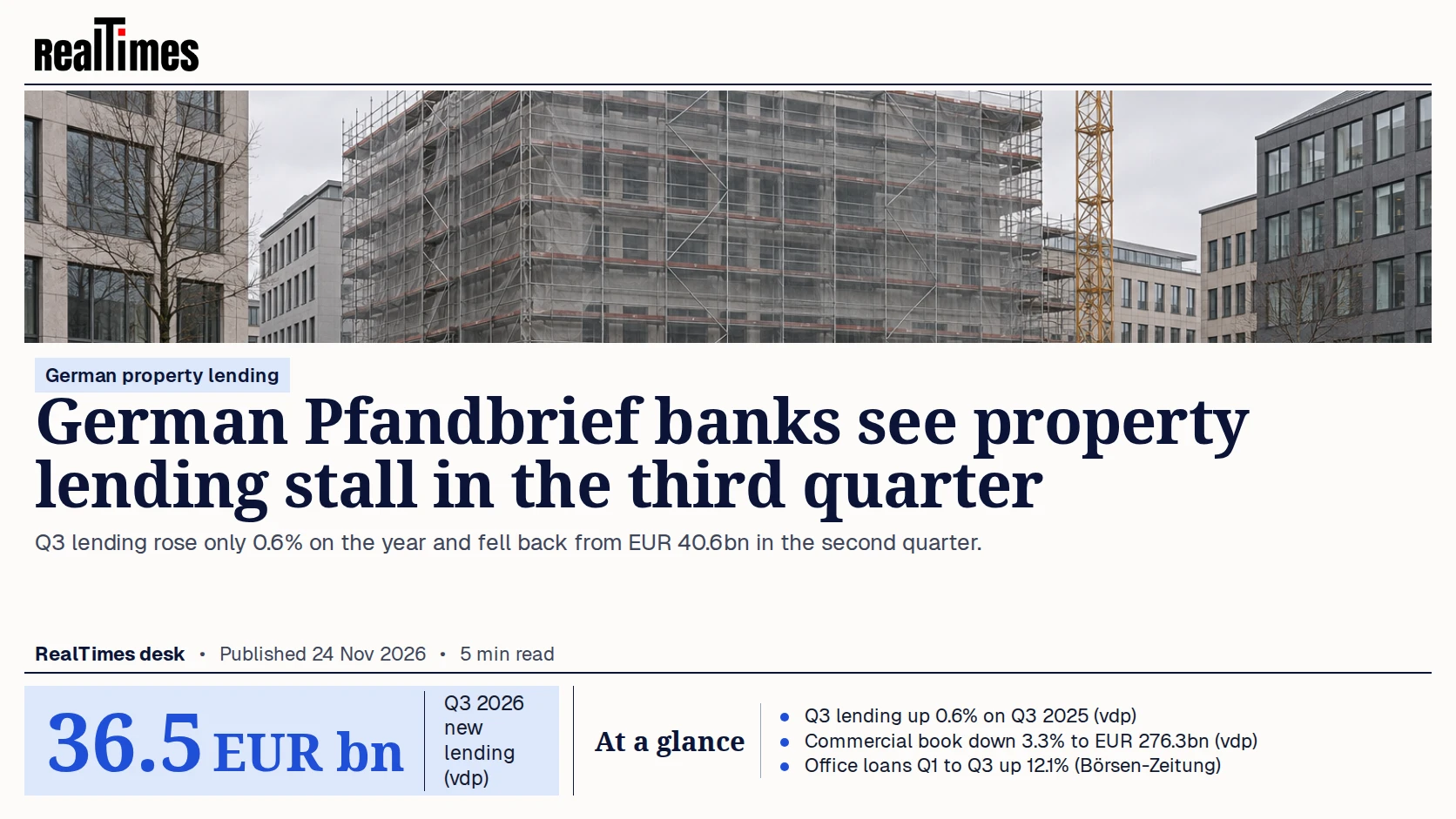
- Member banks of the vdp, the association of German Pfandbrief banks, lent EUR 36.5bn against property in the third quarter, up only 0.6% on a year earlier and down from EUR 40.6bn in the second quarter (vdp; Cash.).
- New commercial lending reached EUR 44.2bn from January to September, up 9.1%, led by offices and retail, yet the commercial loan book fell 3.3% to EUR 276.3bn because new loans did not cover repayments (vdp; Börsen-Zeitung).
- The vdp ties the slowdown to higher interest rates and expects subdued lending in the fourth quarter and a sideways movement for 2026 as a whole (vdp; Börsen-Zeitung).
The nine-month total still looks healthy. Germany's Pfandbrief banks granted EUR 116.9bn of new property loans between January and September, 5.9% more than a year earlier, the vdp reported on 18 November. The third quarter tells a different story: lending barely moved on the year and fell back from the spring.
How much did Pfandbrief banks lend in the third quarter?
EUR 36.5bn, against EUR 36.3bn a year earlier, a rise of 0.6% (vdp). The first two quarters brought EUR 39.8bn and EUR 40.6bn, so the third quarter was about 10% below the second, by our calculation from the vdp figures.
New property lending by vdp member banks in 2026, by quarter (EUR bn)
The half-year figures show the slowdown. In August the vdp reported first-half lending of EUR 80.4bn, up 8.5%, with commercial loans up 14.3%. By September the year-to-date growth had narrowed to 5.9% overall and 9.1% for commercial property (vdp). Börsen-Zeitung quotes vdp chief executive Jens Tolckmitt as saying the momentum of the first half faded in the third quarter, a point the vdp release also makes.
Why is the commercial loan book still shrinking?
Because repayments outran new loans. New commercial lending from January to September came to EUR 44.2bn, but the third quarter alone produced EUR 13.9bn, less than the EUR 14.6bn of the first quarter and the EUR 15.7bn of the second (vdp). The outstanding commercial portfolio fell 3.3% on the year to EUR 276.3bn, and the association notes that new business was still not enough to offset repayments. At the end of June the book stood at EUR 278.4bn.
Offices and retail carried the year. Office loans reached EUR 23.2bn, up 12.1%, and loans for retail property (business properties, in the vdp's English release) EUR 11.3bn, up 17.7%, Börsen-Zeitung reports from the vdp data. Office values moved the other way. The vdp's price index of 10 November put third-quarter office prices 3.9% lower than a year before, and Tolckmitt linked that to the sharp rise in financing costs since the start of the year.
New commercial property lending by vdp banks, Q1 to Q3 2026
| Property type | Q1 to Q3 2026 | Change on Q1 to Q3 2025 |
|---|---|---|
| Offices | EUR 23.2bn | up 12.1% |
| Retail (business properties) | EUR 11.3bn | up 17.7% |
| Other commercial | EUR 5.5bn | down 8.3% |
| Hotels | EUR 3.3bn | stable |
| Industrial buildings | EUR 0.9bn | stable |
| Total commercial | EUR 44.2bn | up 9.1% |
Source: vdp, 18 November 2026; percentage changes for offices and retail from Börsen-Zeitung, 18 November 2026.
What changed between the first half and the third quarter?
The cost of money. "The marked increase in interest rates is weighing on both the property price trend and banks' lending business," Tolckmitt said in the lending release. Cash. also cites the clearly higher rates as his reason for the cooling.
The background is a turn in policy. The European Central Bank raised rates twice this year, in June and September, and on 29 October left its deposit rate at 2.5%, Cash. reported. Borrowers felt it quickly. In October the typical rate for a ten-year German home loan was just under 4.5%, up from 3.9% in May and the highest since 2009, according to mortgage broker Interhyp, as Euronews reported.
Is residential lending holding up better?
Only just. Residential loans totalled EUR 72.7bn from January to September, up 4.0%, but the third quarter's EUR 22.6bn was 9.2% below the second quarter (vdp). Multi-family houses grew fastest, by 12.0% to EUR 19.6bn, while lending for condominiums was unchanged at EUR 15.5bn (Cash.). The residential book rose 1.7% to EUR 767.3bn (vdp).
Building permits give a mixed signal. Germany approved 190,200 homes from January to September, up 8.4% (Börsen-Zeitung), but September approvals fell 14.8%, Cash. reports from Destatis data.
What do the banks expect for the rest of 2026?
Little change. The vdp expects subdued new lending in the fourth quarter and a sideways movement for 2026 as a whole, a view Börsen-Zeitung and Cash. both report.
Why it matters
Our view: the third quarter shows that higher rates now limit how much new debt German property can raise. If the deposit rate stays at 2.5% and home loans stay near 4.5%, then quarterly lending is more likely to stay near the EUR 36.5bn of the third quarter than return to the EUR 40.6bn of the second.
For commercial owners the loan book is the number to watch. If new commercial lending keeps running below repayments, as it did when the book fell to EUR 276.3bn, then borrowers with maturing loans compete for a shrinking pool of Pfandbrief bank credit, and office owners, whose prices fell 3.9%, go into those talks with weaker values. If repayments slow while office and retail lending keeps growing, then the book can stabilise even in a sideways year.