
TL;DR
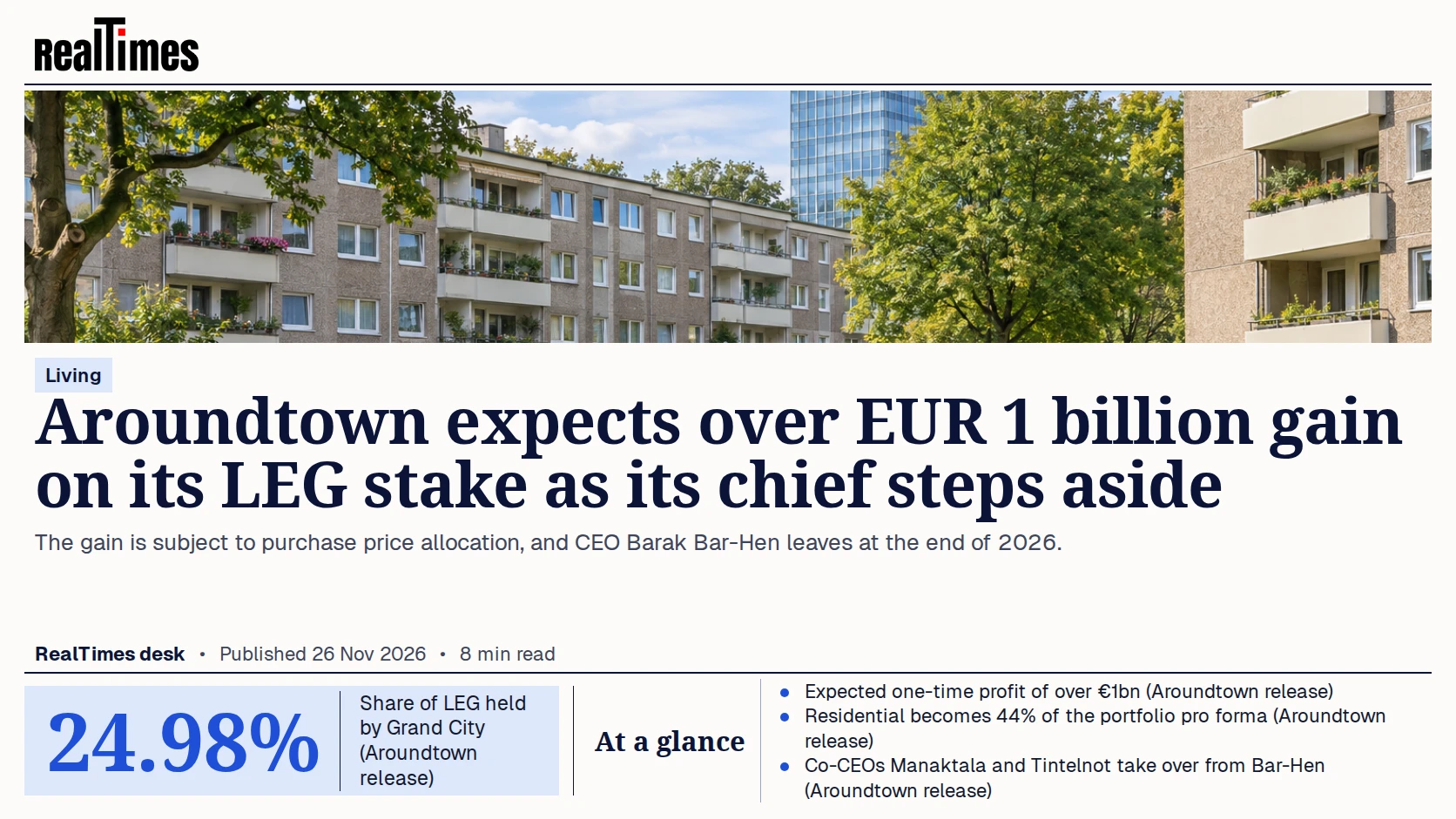
- Aroundtown says its subsidiary Grand City Properties holds 24.98% of LEG Immobilien and expects a one-time profit of over €1bn on the stake, subject to purchase price allocation (Aroundtown release, 25 November; 9M 2026 report).
- Chief executive Barak Bar-Hen steps down as CEO and COO at the end of 2026, and Deputy CEO Kamaldeep Manaktala and CFO Jonas Tintelnot become Co-CEOs (Aroundtown release; Thomas Daily, 25 November).
- Pro forma with LEG, residential becomes the largest segment at 44% of the portfolio, and the living segment, residential plus hotels, reaches 61% (Aroundtown release).
- Nine-month FFO I was €215m against €221m a year earlier, and full-year guidance was narrowed upwards to €285m to €305m (Investing.com, 25 November).
Aroundtown said in its nine-month results release that it expects a one-time profit of more than €1bn on a stake in LEG Immobilien, which its 9M 2026 report makes subject to purchase price allocation, and in the same release it announced that its chief executive is leaving at the end of the year. The two items arrived together on 25 November, with nine-month results in which higher finance expenses pulled FFO I below last year's level.
What has Aroundtown's subsidiary bought?
Grand City Properties (GCP), the Aroundtown subsidiary, holds 24.98% of LEG Immobilien as of the date of the report, according to the Aroundtown release of 25 November. The release calls LEG one of Germany's largest residential real estate companies, with a portfolio of about €20bn concentrated in North Rhine-Westphalia. Investing.com reports the same 24.98% stake, and Thomas Daily describes it as a holding in LEG built through Grand City.
The group keeps its options open. The release says it may, at its discretion, raise the stake to as much as 29.9% of LEG's shares or sell all or part of it at any time, depending on market conditions.
Aroundtown's LEG stake: the position on record
| Item | What is on record | Source |
|---|---|---|
| Stake | 24.98% of LEG's shares, held through GCP | Aroundtown release |
| Ceiling | Up to 29.9%, or a sale of all or part | Aroundtown release |
| LEG portfolio | About €20bn, mainly North Rhine-Westphalia | Aroundtown release |
| Expected profit | Over €1bn, one-time, subject to purchase price allocation | 9M 2026 report |
| Expected FFO I effect | About 20% accretion for Aroundtown, pro rata, after financing costs | Aroundtown release |
| Bridge financing | €600m facility signed after the reporting period, connected to the LEG transaction | Aroundtown release |
Sources: Aroundtown release, 25 November 2026; Aroundtown 9M 2026 report; Investing.com, 25 November 2026.
How big is the expected gain, and has it been booked?
Not yet. The release says the shares were acquired "at a substantial discount to book value" and that Aroundtown "expects to record a one-time profit of over €1 billion" (Aroundtown release). The 9M 2026 report ties that figure to purchase price allocation, so the final amount depends on that exercise (9M 2026 report). Investing.com reports the same figure as a profit of more than €1bn.
For scale, Aroundtown's profit for the first nine months was €332m, against €882m a year earlier (Aroundtown release). By our calculation, a gain of over €1bn would be more than three times that nine-month figure.
Who takes over from Barak Bar-Hen?
Kamaldeep Manaktala, Deputy CEO, and Jonas Tintelnot, Chief Financial Officer, are jointly appointed Co-CEOs and replace Barak Bar-Hen, who steps down as CEO and COO at the end of 2026 after more than six years, according to the Aroundtown release, with first names from Thomas Daily. Tintelnot stays on as CFO, and Bar-Hen will continue to support management as an adviser during the transition. Thomas Daily and Investing.com both report that he leaves at the end of the year.
Frank Roseen, Executive Director at Aroundtown, said on behalf of the board that Bar-Hen "is passing on a robust company, and has paved the way for growth and strong performance for the upcoming years" (Aroundtown release). The release does not give a reason for the timing.
How far does LEG shift Aroundtown's portfolio?
Pro forma, including Aroundtown's proportional share in LEG, the Aroundtown release gives two readings of the portfolio:
- Residential becomes the largest segment of the group, at 44% of the total portfolio.
- Residential plus hotels, the living segment, reaches 61%.
Thomas Daily describes the group as one that once invested mainly in offices.
The same release says Aroundtown raised its stake in GCP from 62.5% to 85% this year, through a share-to-share exchange offer and open market purchases. GCP is therefore both the channel for the LEG stake and a larger part of the group than before.
What do the nine-month numbers show?
The operating picture is softer than the headline gain suggests. Figures from the Aroundtown release:
- FFO I was €215m, or €0.19 per share, against €221m and €0.20 a year earlier, mainly because of higher finance expenses.
- Net rental income was €884m against €886m, with like-for-like rental growth of 2.6%.
- Profit for the period was €332m against €882m, after a one-time deferred tax income in 9M 2025 and lower revaluation results.
- Loan-to-value (LTV) stood at 45% in September 2026, against 41% in December 2025.
- Cash and liquid assets were €2.2bn, and the average cost of debt was 2.6%.
Full-year FFO I guidance was narrowed upwards to €285m to €305m, from €275m to €305m previously (Aroundtown release). Investing.com's headline describes it as a raised lower end, and Thomas Daily attributes the lift to the expected effect of the LEG stake on operating profit (Thomas Daily).
Why it matters
Our view: if the gain is booked as expected, Aroundtown's reported profit will look very different from the €332m of the first nine months, but it will be a one-time item that depends on purchase price allocation. The recurring case rests on a different number, the ca. 20% FFO I accretion that the company ties to LEG's dividends.
If GCP raises the stake toward 29.9%, then residential would weigh even more than the 44% now shown pro forma, while LTV of 45% leaves less room for financing it. If the group sells instead, then the discount to book value that produced the gain becomes the test of the deal. In both cases the two Co-CEOs will carry the decision from January.