
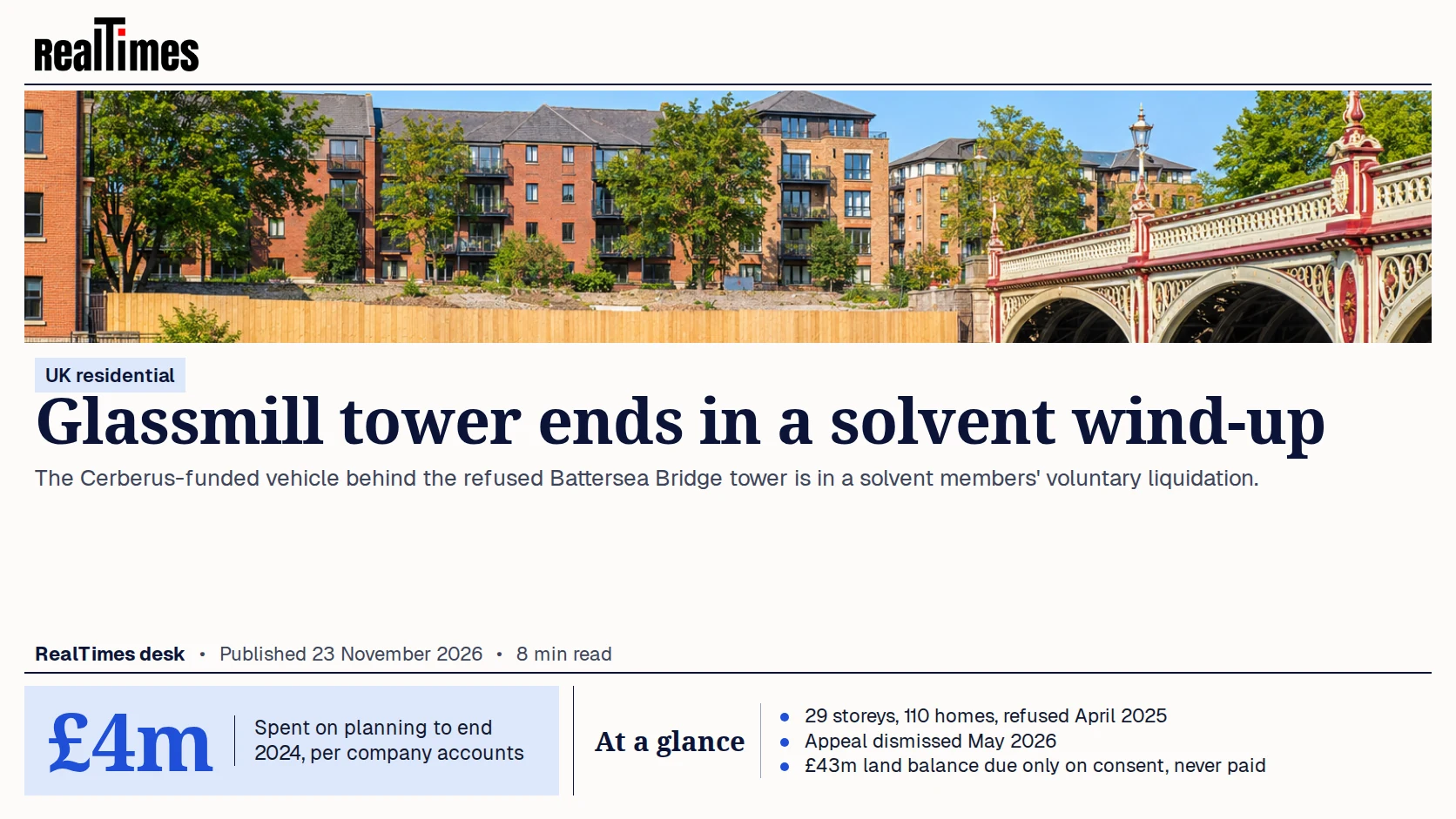
TL;DR
- Promontoria Battersea Ltd, the company behind the Glassmill tower plan at Battersea Bridge, filed four documents at Companies House on 17 November 2026: a special resolution to wind up dated 4 November, the appointment of a voluntary liquidator, a declaration of solvency and a change of registered office.
- This is a members' voluntary liquidation of a solvent company, not an insolvency. Bisnow reported on 18 November that the vehicle was funded by Cerberus Capital Management. Its latest filed accounts show £4.06m of planning costs by the end of 2024.
- The 29-storey, 110-home scheme was refused by Wandsworth in April 2025 and lost its appeal in May 2026, after opposition from residents, heritage bodies and names including Mick Jagger & Eric Clapton.
A private equity backer, a specialist developer and a riverside site that once carried a tall-building allocation: the Glassmill tower had the ingredients that usually get London towers built. It ends instead with four quiet filings and a registered office moved to its liquidator in Basildon, Essex.
What did Promontoria Battersea file, and what does it mean?
The Companies House filing history for Promontoria Battersea Ltd, company number 13446738, shows four filings dated 17 November 2026. The first is a special resolution to wind up the company, dated 4 November. The second is the appointment of a voluntary liquidator. The third is a declaration of solvency, form LIQ01. The fourth moves the registered office to 18a Capricorn Centre, Basildon, Essex.
The declaration of solvency is the document that matters. Two directors swore it on 29 October, stating that the company can pay its debts in full within 12 months, and it is what makes this a members' voluntary liquidation. The attached statement at 15 October lists £52,605 of cash and no liabilities. The liquidator's notice to creditors in The Gazette calls it "a solvent liquidation". In plain terms, the owners are closing a vehicle that no longer has a purpose. Creditors are not taking control of a failed business.
The liquidator, appointed by the company on 4 November, is Gary Thompson of Vantage Restructuring, per the Companies House forms and The Gazette. Bisnow broke the story on 18 November. Neither Cerberus nor Rockwell Property, the development manager, commented to Bisnow. The outlet reads the wind-up as a sign that the project is now dead.
What was the Glassmill tower?
The scheme sat on the south bank of the Thames at Glassmill, 1 Battersea Bridge Road, SW11, in the London Borough of Wandsworth. The council's appeal page lists Promontoria Battersea Limited as the appellant, under application 2024/1322. The plan was to demolish the existing office building and build a part 10, part 28 storey building with homes, offices, community space and a restaurant.
Press reports describe it as a 29-storey tower of 110 homes. Bisnow puts the affordable share at around 50%, and says the site holds a five-storey office building of about 52,000 sq ft. Building adds that Farrells was lead architect, and that the design came down from 36 storeys to 34 and then 29, at about 100 metres.
How did residents and the local plan stop it?
Wandsworth's planning committee refused the application unanimously in April 2025, as City AM reported on 25 April 2025. City AM counted more than 2,000 public objections and more than 6,000 petition signatures; Building gives the same order: more than 2,000 objections and two petitions with 6,000 signatures. Opponents included Mick Jagger, Eric Clapton and Felicity Kendal. Historic England, The Chelsea Society and The Battersea Society objected too, as did the neighbouring Royal Borough of Kensington and Chelsea.
The owner appealed. A public inquiry was scheduled for eight days in March 2026, according to the council. The council page lists livestream sessions for all eight days. The Planning Inspectorate dismissed the appeal in May 2026, Building reported on 18 May. Inspector Joanna Gilbert found the scheme "contrary to the development plan taken as a whole". She gave "very substantial weight" to the harm to the area's character, while accepting the housing benefits. Building reports that Wandsworth's local plan had limited the site to mid-rise development in 2021.
| Step | Date | Source |
|---|---|---|
| Application 2024/1322 submitted | April 2024 | Building; Wandsworth Council |
| Unanimous refusal by Wandsworth committee | April 2025 | City AM |
| Public inquiry | 17 to 27 March 2026 | Wandsworth Council |
| Appeal dismissed | May 2026 | Building |
| Special resolution to wind up; liquidator appointed | 4 November 2026 | Companies House; The Gazette |
| Liquidation filings incl. declaration of solvency | 17 November 2026 | Companies House |
What did the investor lose?
According to the Promontoria accounts, first reported by Bisnow, the company paid a £1.75m deposit on the site in 2021, out of a total price of £45m. The balance of about £43m was due only once planning was achieved. The accounts to the end of 2024, the latest filed, carry £4.06m, about £4m, of capitalised planning costs, before the 2026 appeal.
That structure is the instructive part. Because most of the land price was conditional on consent, the refusal never triggered the £43m payment. The money at risk was around £4m of planning spend plus the £1.75m deposit, which no longer appears among the assets in the declaration of solvency, and the directors declared the company solvent at the close. The money that went was the money spent on trying.
Why it matters
Our view: Glassmill shows that a well-funded owner cannot buy its way past a clear local plan. The local plan had limited the site to mid-rise in 2021, years before the application, per Building, and the inspector found the scheme contrary to the plan as a whole. Opposition from residents, heritage bodies and well-known neighbours added weight, but the plan policy did the work.
For anyone valuing a residential tower on a site without consent, the lesson is to price planning as a yes or no event, not as a discount to be negotiated down. Where the local plan caps height, the value of the extra storeys is an option that may expire at nothing. Glassmill's conditional land deal is the template for owning that option cheaply: a small deposit, a large payment only on consent, and a vehicle that can be wound up solvently when the answer is no.
The same logic cuts the other way for landowners. A seller who accepts most of the price on a consent condition carries the planning risk too, and in this case the £43m balance never became due.