
TL;DR
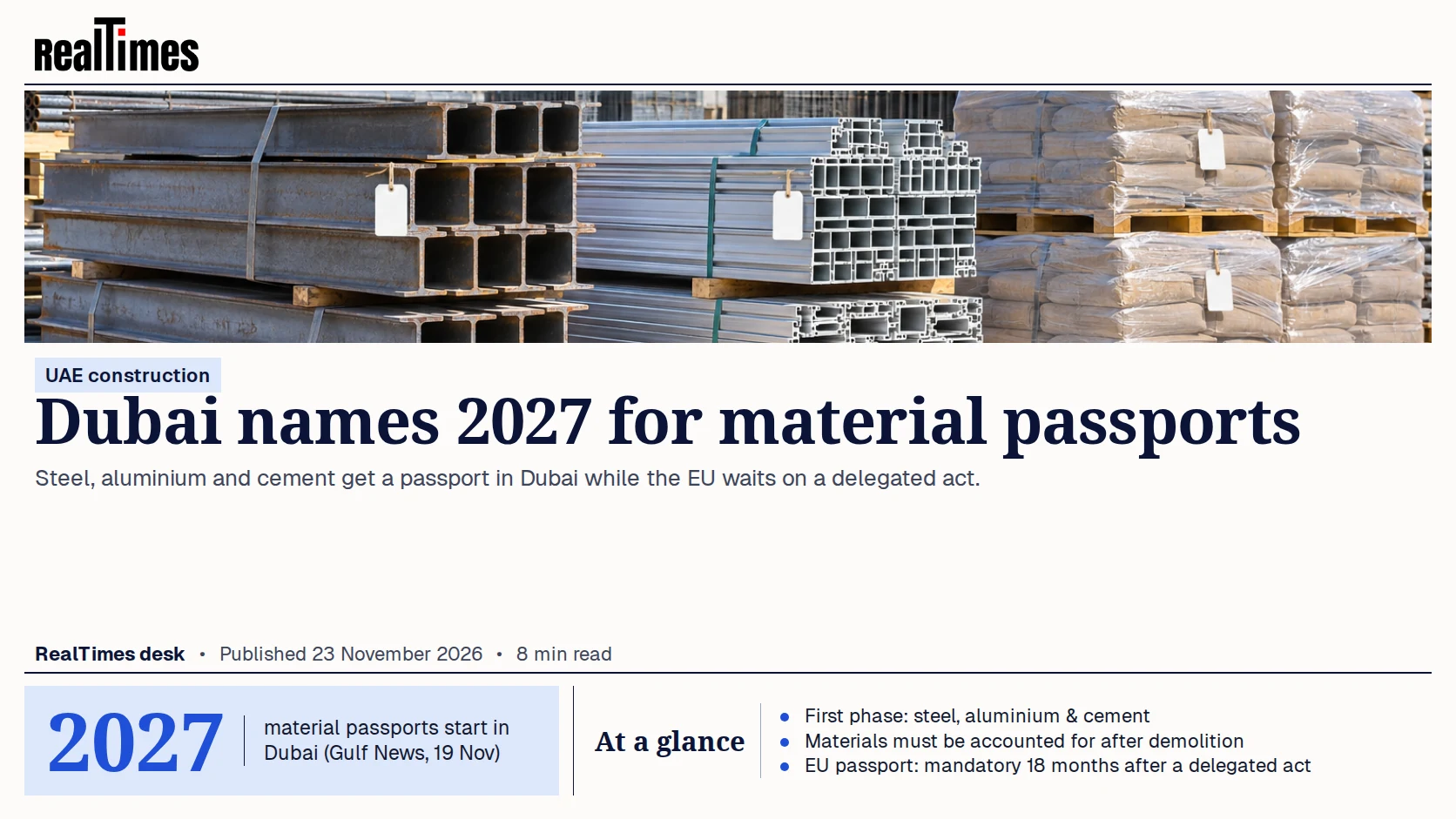
- Dubai Municipality told Gulf News at Dubai Future Week 2026 that its Building Materials Passport will be released at the beginning of 2027, and that compliance will be mandatory for everyone in the emirate's construction industry, including all manufacturers and suppliers.
- The first phase covers steel, aluminium and cement. Each material leaving the laboratory gets its own number in a central system run by the municipality, and after demolition those responsible for a building must account for the materials on its list of passports, including why anything was not recycled, as reported by Gulf News and AlCircle.
- The EU's revised Construction Products Regulation already provides for a digital product passport, but the system still needs a separate Commission delegated act, and becomes mandatory 18 months after it, according to Germany's DIBt. For European developers & suppliers, Dubai now offers a model with a 2027 timetable to compare against.
Construction has run on a straight line, as Gulf News describes it: materials are bought, used and, once a building is demolished, taken to landfill. Dubai wants to change the end of that story. The city plans to give three building materials, steel, aluminium and cement, a passport, and to ask those responsible for a building to explain what happened to the materials on its list after demolition.
What did Dubai Municipality announce?
At Dubai Future Week 2026, which opened on Wednesday 18 November, Dubai Municipality revealed to Gulf News that the Building Materials Passport will be released at the beginning of 2027. The paper's report is dated 19 November. Salama Al Suwaidi, architectural engineer at the municipality's Building Permits Department, presented the project at Emirates Towers and said compliance will be mandatory for everyone in the emirate's construction industry, including all manufacturers and suppliers.
The initial phase covers only three materials: steel, aluminium and cement. Al Suwaidi said the ambition is to target everything eventually, per Gulf News. AlCircle, the aluminium industry outlet, reported the same plan on 19 November, describing the system as scheduled for launch in early 2027 with the initial rollout covering aluminium, steel and cement.
The platform behind it is not new. On 20 October, at the WETEX 2026 exhibition, Dubai Municipality showcased a Building Materials Passport Platform that provides a structured digital record of construction material specifications throughout their lifecycle. The municipality said the platform covers design, production, transportation and installation through to processing, dismantling, reuse and end-of-life management. What the November presentation adds is the mandate, the 2027 release and the first three materials.
How will the passport work?
The mechanics, as Gulf News reported them, run through a single registry. Each material that leaves the laboratory will have its own number, information and specifications recorded in a central system managed by the municipality. Manufacturers or suppliers apply through the system and provide the technical details, and the municipality issues the passport on that basis. If the details do not match the required standards, the material is deemed invalid.
The passport follows the product, not the category. Cement from different companies will each carry a different passport, per Gulf News. We read that, together with the list of passports each building will carry, as a registry able to show whose material went into which building.
What happens when a building comes down?
This is the part that goes furthest. After demolition, materials will be taken to laboratories and tested. Al Suwaidi gave the example of steel found to have 50% of its strength: it would be fortified and treated so it can be used again in new buildings. "It's a life cycle that does not end," she said, as reported by Gulf News. A material leaves that cycle only when it is no longer usable and must go to landfill for safety reasons.
Those responsible for a building will be asked to account for the materials on its list of passports, including why something was not recycled after demolition, and all recyclable materials from demolition sites will have to be recycled, according to Gulf News. AlCircle reports the same duty to account for the materials listed in the passports. The stated aims are to reduce reliance on imported materials, cut costs, lower carbon emissions and make construction more sustainable.
Where does the EU stand?
Europe has the law but not yet the switch. Regulation (EU) 2024/3110, the revised Construction Products Regulation, was adopted in November 2024, entered into force on 7 January 2025, and its main part became applicable on 8 January 2026, according to the European Commission. The Commission describes a new system that will provide accurate, machine-readable information about construction products throughout their life cycle, combining the declaration of performance and conformity with other documents the regulation requires.
The passport does not start on its own. The digital product passport system under the new regulation will be instituted by a separate delegated act of the Commission and will be mandatory 18 months after it, Germany's construction products authority DIBt explains. The Commission's regulation page lists no date for that act. In December 2025 the Commission published its first working plan under the regulation, covering 2026 to 2029, per the same Commission page.
Dubai and the EU compared
| Dubai Building Materials Passport | EU construction products passport | |
|---|---|---|
| Legal basis | Dubai Municipality system, presented at Dubai Future Week 2026 | Regulation (EU) 2024/3110 |
| Start | Release at the beginning of 2027 | 18 months after a Commission delegated act |
| First scope | Steel, aluminium & cement | Construction products; system set up by a delegated act |
| Lifecycle | Design to end-of-life, with post-demolition accounting | Information throughout the product life cycle |
Sources: Gulf News, Dubai Municipality, European Commission, DIBt.
Why it matters
Our view: Dubai has turned the material passport from a concept into a mandatory scheme for steel, aluminium and cement, with a release at the beginning of 2027 reported by Gulf News, while the EU passport still waits for a delegated act and an 18-month lead time. The demolition clause is the real shift: it puts the record of a building's materials in front of those responsible for the building at the end of its life, not only in front of the supplier at delivery.
If Dubai's registry starts on time and the post-demolition accounting is enforced, then European steel, aluminium and cement suppliers selling into the emirate will have to file product data in Dubai's format before the EU asks for its own, and developers will hold a live test of what a material passport costs and returns. If the start slips or the accounting stays light, then the scheme remains a database, and the EU's slower, regulation-led route sets the template for both markets.