TL;DR
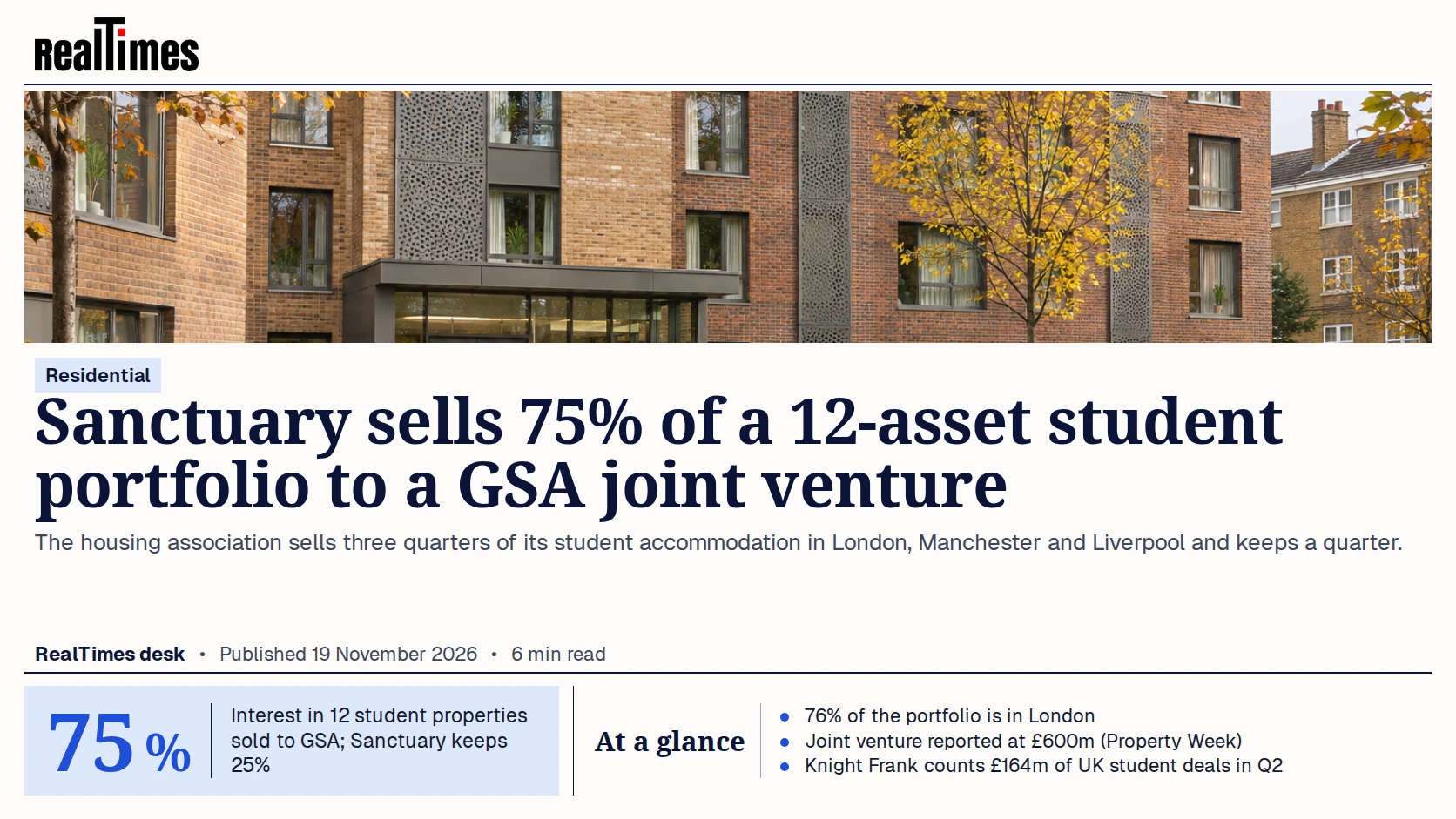
- Sanctuary, a housing association, has agreed to sell a 75% interest in 12 student accommodation properties in London, Liverpool and Manchester to Global Student Accommodation (GSA), and keeps 25%, according to Sanctuary's release.
- Property Week reports the joint venture at £600m, a figure that covers the purchase price and an immediate capital injection to reposition the portfolio.
- The sale arrives in a UK student market where Knight Frank counts £2.3bn of first-half 2026 deals but only £164m in the second quarter.
Sanctuary, which owns around 125,000 units of accommodation, is turning part of its student accommodation business into capital for social housing and care. It announced the agreement on 16 November (Sanctuary). GSA, a specialist student accommodation investment manager, is the buyer, acting for a joint venture with an institutional investor that has not been named.
What exactly has Sanctuary agreed to sell?
A three-quarter stake, not the whole portfolio. Sanctuary has agreed to sell a 75% interest in 12 properties and will keep 25% and a seat on the new partnership's board. Housing Today describes the same structure and adds that about three quarters of the portfolio sits in London, most of it in the central zone 1 area.
The buildings are the larger story for investors. GSA says 76% of the portfolio is in London, mostly in zone 1, with the rest in Manchester and Liverpool. BE News adds that several of the buildings operate under nominations agreements with local universities, which give long-term income.
Is it really a £600m deal?
It is a £600m joint venture, and that is not the same as a sale price. Property Week, BE News and Urban Living News each put the venture at about £600m, and Property Week and Urban Living News state that the figure includes the purchase price and an immediate capital injection to reposition the portfolio. Sanctuary's release does not give a value, and Housing Today reports none.
How the £600m splits between price and refurbishment is therefore not public. What the release does set out is the plan for the buildings: GSA will provide asset management and invest in significant improvements, while its brand and operator Yugo takes on day-to-day management. BE News describes a phased capital programme covering rooms, amenity space and building performance, with Yugo operating the portfolio once the refurbishment is complete.
The deal at a glance
| Item | What has been published |
|---|---|
| Seller | Sanctuary, keeps 25% and a board seat (Sanctuary) |
| Buyer | GSA, for a joint venture with an institutional investor (Sanctuary) |
| Portfolio | 12 properties in London, Liverpool and Manchester, 76% in London (Sanctuary) |
| Joint venture value | About £600m, purchase price plus capital injection (Property Week) |
| Operator | Yugo (Housing Today) |
Source: Sanctuary, Property Week, Housing Today. All first published 16 November 2026.
Why is a housing association selling student buildings?
To fund its core business. Sanctuary says the proceeds will go into social housing and care, including maintaining existing homes and supporting new ones. Its chief executive says housing providers are looking for new ways to generate the financial capacity to keep investing, and the 25% it retains means it still shares in the venture's future.
The buyer's argument is about selection. GSA's head of real estate says the firm looks past short-term sentiment to sector fundamentals and that locations like these rarely come with so much room to add value (Property Week). Property Week also reports that GSA has committed to deploy more than €1bn (£830m) across Europe and the UK.
What is the market behind the deal?
A recovering but choosy one. Knight Frank counts £2.3bn of UK student housing transactions in the first half of 2026, ahead of the same period of 2025, yet only £164m in the second quarter, one of the weakest quarters on record, with 13 deals. The agency puts part of the slowdown down to buyers and sellers disagreeing on price, and says it was tracking more than £1.5bn of assets under offer.
Lenders add pressure. In a Savills and Class Foundation survey of 19 European investors and operators, nine in 10 respondents rank the cost of borrowing as a concern, and five-year swap rates are more than 100 basis points higher than a year earlier. The same survey puts the UK at 13% of target locations, behind Spain and level with Italy.
Why it matters
Our view: a London-weighted portfolio with a refurbishment budget has found a buyer at a moment when the wider market is thin, which says that scale and location still clear while price discovery elsewhere is slow.
If the venture's reported £600m is followed by more disposals from social landlords, then the £1.5bn of assets under offer that Knight Frank tracks could convert faster. If borrowing stays more than 100 basis points dearer than a year ago, then deals will keep favouring buyers with equity and a plan for the buildings, as in this one.