
TL;DR
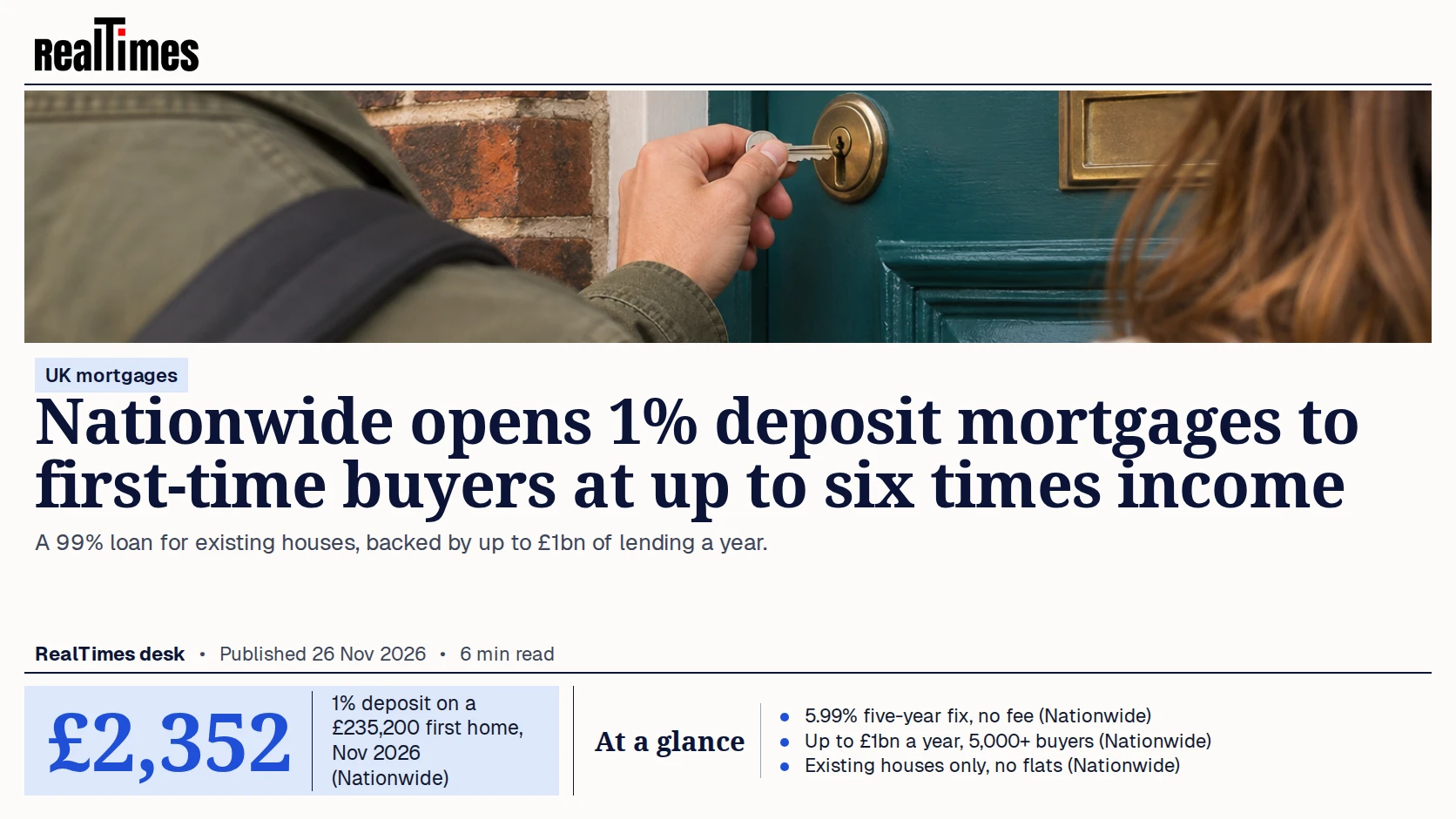
- Nationwide has launched the Helping Hand 1% Deposit Mortgage: a 99% loan for first-time buyers, at up to six times income, on a five-year fix at 5.99% with no fee (Nationwide, 25 November; Mortgage Strategy).
- The society plans to lend up to £1bn a year through the product, which it expects to bring in more than 5,000 additional first-time buyers a year (Nationwide; The Guardian).
- The loan covers existing houses only, without flats, new builds or self-employed applicants, and brokers warn that a small fall in prices could push borrowers into negative equity (PA via Yahoo Finance; The Guardian).
The deposit has long been the wall that keeps renters out of ownership. On Wednesday Nationwide lowered it to a step. Its new Helping Hand 1% Deposit Mortgage lets eligible first-time buyers borrow 99% of a home's value and up to six times their income (Nationwide). The money behind the product is large: up to £1bn of lending a year (Nationwide; The Guardian).
Henry Jordan, Nationwide's group director of mortgages, framed it as an answer to a squeeze "from both directions": saving enough for a deposit, and being able to borrow enough to buy (Mortgage Strategy).
What does the 1% deposit change for a buyer?
On Nationwide's average first-time buyer home of £235,200, a 1% deposit is £2,352, against £11,760 at 5%. Someone putting aside 5% of average monthly net pay could reach the smaller sum in 15 months instead of five years and nine months (Nationwide; Mortgage Strategy).
The gap is widest in the capital. Nationwide's regional table puts the average London first-time buyer home at £450,417, where a 1% deposit takes about two years to save and a 5% deposit about nine. In the North, on an average of £138,648, the same saver needs 10 months for 1% and three years and ten months for 5% (Nationwide).
The pitch is also about family money. Nationwide cites the English Housing Survey: 37% of first-time buyers rely on some gifted deposit (Nationwide; Mortgage Strategy). Its own lending data for the 2025/26 financial year shows gifts made up 61% of the deposit among Helping Hand buyers who used gifted money, against 67% for comparable buyers outside the scheme (Nationwide).
Helping Hand 1% Deposit Mortgage: the terms
| Item | Detail |
|---|---|
| Loan to value | 99% |
| Borrowing | Up to six times income |
| Rate | 5.99%, five-year fix, no product fee |
| Minimum income | £30,000 sole, £50,000 joint |
| Property | Existing houses only, no flats or new builds |
| Excluded | Self-employed applicants |
| Sale route | Advised only, through brokers or Nationwide advisers |
| Lending pledge | Up to £1bn a year, more than 5,000 extra buyers a year |
Sources: Nationwide, 25 November 2026; Mortgage Strategy, 25 November 2026.
How has Nationwide fenced the risk?
The product sits on top of Helping Hand, launched in April 2021, which already lends up to six times income and has backed more than 85,000 first-time buyers. Fewer than 0.1% of Helping Hand mortgages are three or more months in arrears (Nationwide; PA via Yahoo Finance). That record was built on deposits of 5% or more, the level Helping Hand required until now (PA via Yahoo Finance; Mortgage Introducer).
The new loan comes with tighter walls. It is only a five-year fix, every applicant must take advice, and the self-employed, flats and new builds are excluded (Nationwide; The Guardian). A broker quoted by Mortgage Strategy puts the maximum loan at £750,000.
The price is not the cheapest on the shelf, but it is not punitive either. Moneyfacts put the market average five-year fix at 95% loan to value at 6.30% on launch day, according to Mortgage Introducer, above the 5.99% Nationwide charges at 99%.
Why are brokers worried about negative equity?
The timing is awkward. The Bank of England raised Bank Rate by 0.25 percentage points to 4% on 5 November (Bank of England). As background, Lloyds said that UK house prices fell 0.6% in October and 1.2% on the year, and Savills expects prices to fall 1.5% in 2027 (The Guardian; Mortgage Introducer).
With 1% down, the equity cushion is thin. On the £235,200 average home the loan would be £232,848, by our calculation, so a 1% fall in value would wipe out the deposit on day one. Brokers quoted by The Guardian and Mortgage Introducer warned that even a small slip in prices could leave borrowers in negative equity, and that the deal suits buyers planning to stay well beyond five years. Jordan's reply to the paper: "I don't think anyone is forecasting a fall in house prices over the next five years." Savills, for its part, expects prices to rise 15.8% over the five years to 2031 (The Guardian; Mortgage Introducer).
Where does this leave new homes?
New builds are outside the product, and that leaves the segment to the state. The government's Your First Home scheme will let first-time buyers in England buy a new-build home with a deposit of at least 2.5% and a 20% government equity loan. It is expected to open for applications in February 2027 (GOV.UK). In practice the market now splits in two: Nationwide's 1% route for existing houses, and a state-backed route for new homes from participating developers (GOV.UK; Mortgage Introducer).
Why it matters
Our view: the product tests how far lenders can stretch demand for existing houses. If Nationwide fills its £1bn a year pledge, then more than 5,000 extra buyers a year reach the bottom of the ladder. That supports transactions and the owners trading up behind them. New-build demand meanwhile waits for Your First Home in 2027.
If prices follow the 1.5% fall Savills expects for 2027, then after 12 to 24 months of repayments at 5.99% the loan would still be about 98% to 99.6% of the home's value, by our calculation. Early borrowers would have almost no equity when they want to move, and the arrears record of below 0.1% becomes the number lenders and regulators will watch. If prices instead track the 15.8% five-year forecast, the five-year fix builds equity and other lenders are likely to follow at 99%.